Fasting and Hormonal Optimization: Your 2026 Guide


Fasting and hormonal optimization are directly linked: strategic periods of caloric restriction trigger measurable shifts in insulin, leptin, ghrelin, testosterone, and growth hormone that reshape your metabolic and reproductive health. Clinicians and researchers now use the term endocrine modulation through fasting to describe these adaptive changes, though most practitioners still reach for the more familiar phrase. Protocols like intermittent fasting (IF) and time-restricted eating (TRE) have been studied in randomized trials published in Nature Communications and reviewed by Cochrane, giving us a clearer picture of what fasting actually does to your hormones and what it does not. The effects are real, but they are also sex-specific, context-dependent, and far more nuanced than most fitness content suggests.
How does fasting and hormonal optimization work at the metabolic level?
Fasting reshapes three metabolic hormones faster than almost any other dietary intervention: insulin, leptin, and ghrelin. Understanding what each one does during a fast explains why so many people report improved energy, reduced cravings, and better body composition after adopting a structured fasting protocol.

Insulin sensitivity is the most well-documented benefit. When you stop eating, circulating glucose drops, insulin secretion falls, and cells gradually become more responsive to the hormone. This matters because chronically elevated insulin drives fat storage and suppresses fat oxidation. Lower insulin during fasting windows is the physiological foundation of the fasting metabolism boost most people experience.
Leptin and ghrelin tell the opposite sides of the hunger story. A 2026 randomized crossover trial on adults with overweight and type 2 diabetes found that TRE decreased fasting leptin by approximately 2,445 ng/mL while increasing fasting ghrelin by roughly 28 pg/mL, alongside a spontaneous calorie reduction of about 384 kcal per day. Leptin is the satiety signal your fat cells secrete; lower leptin during fasting reflects reduced fat mass and improved receptor sensitivity over time. Ghrelin is the hunger trigger, and its rise during fasting is the mechanism behind the fasting and hormonal hunger reset that experienced fasters describe: your body learns to tolerate and then regulate hunger rather than panic at the first signal.
Insulin drops during fasting windows, improving cellular glucose uptake and reducing fat storage signals
Leptin decreases with sustained fasting, which gradually recalibrates satiety sensitivity
Ghrelin rises short-term but stabilizes with consistent fasting practice, reducing reactive hunger
Growth hormone surges during extended fasts, supporting lean mass preservation and fat mobilization
Pro Tip: Metabolic context changes everything. A person with insulin resistance will see faster and more dramatic hormonal shifts from fasting than a lean, metabolically healthy individual. Baseline health status is the single biggest predictor of how quickly your hormones respond.
What are the sex-specific hormonal responses to fasting?
Sex differences in hormonal fasting responses are among the most underreported findings in the fasting literature, and ignoring them leads to protocols that work brilliantly for one person and backfire for another.
In men, the picture is mixed. Fasting reduces total and free testosterone in lean, active young men, with the mechanism traced to hypothalamic suppression of LH pulses rather than changes in secretion frequency. The practical implication is counterintuitive: despite lower testosterone readings, muscle mass and strength are preserved in most trials. Obese men show a different pattern entirely, with longer-term TRE producing no significant testosterone changes, likely because the metabolic improvements offset the suppressive effect of caloric restriction.
In women, the reproductive axis is more sensitive to energy availability. Premenopausal women in a negative energy state can experience disruptions to LH and kisspeptin signaling, the hormonal cascade that governs the menstrual cycle. A 2026 international review confirmed that IF modestly decreases androgens in premenopausal obese women, which is actually a therapeutic benefit for conditions like polycystic ovary syndrome (PCOS). SHBG effects vary considerably by population and fasting duration.
Hormone | Effect in men | Effect in women |
Testosterone | Decreases in lean men; unchanged in obese men | Androgens decrease in premenopausal obese women |
LH pulsatility | Suppressed during extended fasting | Sensitive to energy deficit; may disrupt cycle |
Leptin | Decreases with calorie deficit | Decreases; may affect reproductive signaling |
SHBG | Variable | Variable; influenced by metabolic status |
Growth hormone | Increases during fasting | Increases; magnitude varies by body composition |
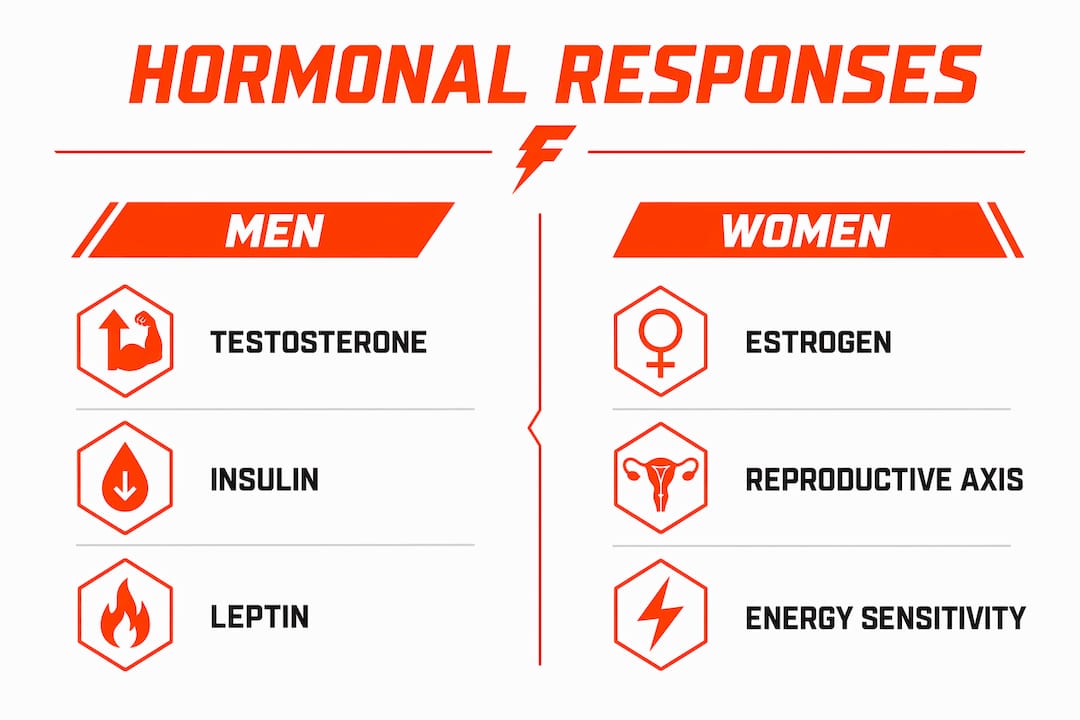
The clinical takeaway is that hormonal effects of fasting are not universally harmful or beneficial. They are context-dependent. A lean woman training hard with an aggressive fasting window faces different risks than an obese woman using moderate TRE to address metabolic syndrome.
Pro Tip: If you are a premenopausal woman and notice cycle irregularities within the first month of fasting, shorten your fasting window before extending it again. The reproductive axis responds to perceived energy scarcity faster than any other hormonal system.
How do different fasting methods compare for hormonal outcomes?
Not all fasting protocols produce the same hormonal profile. The three most studied approaches each have distinct mechanisms and trade-offs.
Intermittent fasting (16:8 or 18:6) is the most practiced format. You eat within a 6 to 8 hour window daily. Insulin drops reliably, growth hormone rises during the fasting window, and hunger hormones stabilize within two to four weeks for most people. A six-month IF intervention published in Nature Communications produced 8% bodyweight loss and 16% fat loss, alongside improved lipid profiles and downregulation of GLP-1 and enteroendocrine hormone transcripts. That molecular data matters: it shows IF does not just change body weight but rewires the hormonal machinery governing appetite and lipid metabolism.
Time-restricted eating (TRE, 20:4) is more aggressive and produces faster hormonal shifts, as the 2026 crossover trial data on leptin and ghrelin demonstrates. The trade-off is adherence. A four-hour eating window is difficult to sustain socially and nutritionally, and the risk of micronutrient deficiency rises sharply.
Alternate-day fasting (ADF) alternates full fast days with unrestricted eating days. Cortisol tends to spike more on fast days compared to daily IF, which is a consideration for anyone managing stress-related hormonal imbalances. ADF produces strong insulin sensitivity gains but is the hardest protocol to maintain long-term.
16:8 IF: Best for beginners; reliable insulin and growth hormone benefits; easiest to sustain socially
20:4 TRE: Faster leptin and ghrelin recalibration; higher adherence challenge; requires careful nutrient density
Alternate-day fasting: Strong metabolic gains; elevated cortisol on fast days; poor long-term adherence in most populations
5:2 protocol: Two very low-calorie days per week; moderate hormonal effects; good option for those who struggle with daily windows
What practical steps personalize fasting for hormonal health?
Personalizing your fasting protocol starts with an honest assessment of your metabolic baseline. Someone managing type 2 diabetes, obesity, or thyroid dysfunction needs a different entry point than a metabolically healthy person optimizing performance. Fasting and thyroid health deserve particular attention: aggressive caloric restriction can suppress T3 production, so anyone with hypothyroidism should begin with shorter fasting windows and monitor thyroid markers at three-month intervals.
Monitoring hormone responses accurately requires more than a single morning blood draw. Circadian-aware hormone sampling, using 24-hour cortisol profiling and timed measurements, captures the full amplitude and phase of fasting-induced hormonal rhythms that a standard 8 a.m. lab panel misses entirely. If you are working with a clinician, request timed sampling rather than a single timepoint.
The refeeding phase is where most self-directed fasters make their biggest mistakes. Refeeding after prolonged fasting is the least standardized aspect of fasting practice, yet macronutrient sequencing and caloric progression during the eating window directly influence insulin response, electrolyte balance, and thyroid rebound. Breaking a fast with high-glycemic foods causes an insulin overshoot that undermines the hormonal benefits accumulated during the fast itself.
Start with a 12-hour fast and extend by one hour per week rather than jumping to 16:8 immediately
Break your fast with protein and fat before carbohydrates to moderate the insulin response
Track energy, sleep quality, and mood as proxy indicators of hormonal adaptation before running labs
Avoid extending fasting windows during periods of high training load, acute stress, or illness
For women, consider a cyclical approach that shortens the fasting window during the luteal phase
Pro Tip: The psychology of controlled hunger is as important as the biology. Fasting fails most often not because of hormonal incompatibility but because of unmanaged psychological responses to hunger. Build the mental framework before you extend the window.
Key takeaways
Fasting optimizes hormonal health through measurable changes in insulin, leptin, ghrelin, and testosterone, but the magnitude and direction of those changes depend entirely on your sex, metabolic status, and the fasting protocol you choose.
Point | Details |
Insulin and leptin respond first | Fasting windows reliably lower insulin and recalibrate leptin sensitivity within weeks. |
Sex determines hormonal risk profile | Lean men may see testosterone dips; premenopausal women face reproductive axis sensitivity. |
Protocol choice shapes outcomes | 16:8 IF suits most people; 20:4 TRE accelerates hormonal shifts but demands higher adherence. |
Refeeding is not optional | Macronutrient sequencing during the eating window directly protects thyroid and insulin balance. |
Calorie deficit is a key driver | Many hormonal benefits attributed to fasting timing are partly driven by the calorie deficit it creates. |
Why I think most people are fasting for the wrong reasons
Most people come to fasting chasing a number on the scale. The hormonal story is far more interesting and far more useful than that. After years of working through the research and applying these principles, what strikes me most is how caloric deficit confounds hormone responses in ways that most fasting advocates quietly ignore. The Cochrane review of 22 RCTs found that IF produces little difference in weight loss compared to standard dietary advice at 12 months. That finding does not make fasting useless. It makes the hormonal and metabolic mechanisms the actual argument for fasting, not the weight loss.
What I find genuinely compelling is the molecular data from long-term IF trials showing changes in enteroendocrine hormone transcripts and lipid metabolism pathways. That is not a calorie-counting outcome. That is structural biological adaptation. The problem is that most people never stay with a protocol long enough or consistently enough to reach that adaptation layer. They extend their window too fast, under-eat protein, skip the refeeding strategy, and then blame fasting when their energy crashes and their hormones signal distress.
The most durable results I have seen come from people who treat fasting as a lifestyle framework rather than a diet phase. That means building the mental tolerance for hunger, designing a refeeding approach that supports thyroid and reproductive health, and adjusting the protocol based on real feedback from their body rather than a rigid schedule. Fasting is not a protocol you follow. It is a skill you develop.
— Tony
Start building your fasting framework with Forgefastmethod

Forgefastmethod was built specifically for people who want more than a fasting timer. The ForgeFast method integrates the hormonal science covered in this article into a structured, personalized framework that accounts for your metabolic baseline, sex-specific needs, and refeeding strategy. It is not a generic 16:8 plan. It is a system that builds the psychological and biological foundations for lasting hormonal health and fat loss. The ForgeFast app tracks your fasting windows, guides your refeeding phase, and adapts your protocol as your body responds. If you are ready to apply these principles with structure and support, Forgefastmethod is where to start.
FAQ
How does fasting improve insulin sensitivity?
Fasting lowers circulating glucose and reduces insulin secretion, which allows insulin receptors to reset their sensitivity over time. Consistent fasting windows of 14 to 16 hours produce measurable improvements in insulin response within two to four weeks for most adults.
Does intermittent fasting lower testosterone in men?
Fasting modestly reduces total and free testosterone in lean, active men through hypothalamic suppression of LH pulses, but muscle mass and strength are preserved in clinical trials. Obese men show no significant testosterone reduction with longer-term TRE.
Is fasting safe for women’s hormonal health?
Moderate fasting protocols are generally safe for most women, but the female reproductive axis is sensitive to energy deficits. Premenopausal women should monitor for cycle changes and shorten fasting windows if irregularities appear, particularly during high-stress or high-training periods.
What is the best fasting method for hormonal balance?
The 16:8 intermittent fasting protocol offers the most consistent hormonal benefits with the highest adherence rates across populations. More aggressive protocols like 20:4 TRE produce faster hormonal shifts but carry greater adherence and nutritional risk.
Why does the refeeding phase matter for hormones?
Breaking a fast incorrectly triggers an insulin overshoot that can disrupt thyroid function and electrolyte balance. Macronutrient sequencing during refeeding directly determines whether the hormonal benefits of fasting are preserved or undermined.
Recommended
Comments