Start 12:12 Fasting on GLP-1: Protect Muscle With 1.2–1.6 g/kg Protein
Most people on GLP-1 medications can add gentle intermittent fasting, but only after their dose has stabilized, and never on top of insulin or a sulfonylurea without a clinician’s sign-off. The safest path starts with a 12:12 or 16:8 window, not a full-day fast, and puts protein and hydration ahead of restriction. If you’re cleared to try it, the job becomes tracking glucose, fluids, and how much protein you’re actually eating.
TL;DR:
Combining GLP-1 medications and fasting is safe only after dose stabilization and with careful monitoring of glucose, hydration, and protein intake.
Both approaches lower insulin levels and promote fat burning, but GLP-1 can suppress hunger so effectively that it may mask warning signs of low blood sugar during fasting.
No large human studies confirm that fasting plus GLP-1 outperforms GLP-1 alone for weight loss, so safety and practical protocols should take precedence.
Fasting should start with 12:12 windows and not exceed 16:8 until well tolerated, ensuring protein intake and hydration are prioritized to prevent muscle loss and dehydration.
Combining these methods requires close medical oversight, especially for individuals on insulin or sulfonylureas, and should focus on habit-building rather than aggressive restriction.
Table of Contents
Does GLP-1 and Intermittent Fasting Actually Overlap?
GLP-1 receptor agonists and intermittent fasting hit some of the same metabolic switches through completely different routes, which is exactly why people assume they stack neatly. They don’t always.
GLP-1 drugs work by mimicking a gut hormone that slows stomach emptying, blunts appetite signals in the brain, and boosts insulin release only when blood sugar is already high (a glucose-dependent effect, which is part of why hypoglycemia risk is lower on GLP-1 alone than with older diabetes drugs). Intermittent fasting works through timing, not chemistry: stretch the gap between meals long enough and insulin drops, the body shifts toward burning fat for fuel, and cellular pathways like AMPK activation and mTOR suppression kick in, the same “metabolic switching” that shows up in fasting research summarized by clinical reviewers.
Where they genuinely overlap:
Both tend to lower circulating insulin and shift the body toward fat oxidation.
Both can reduce total daily calorie intake without much conscious effort.
Both may improve insulin sensitivity over weeks, though through different mechanisms.
Where they diverge matters just as much. GLP-1 suppresses hunger pharmacologically, whether or not you’re near a meal. Fasting relies on your body tolerating a hunger window on its own. Combine the two, and something practical happens: GLP-1 often mutes hunger cues so effectively that you stop noticing normal warning signs, like lightheadedness or the urge to eat, that would otherwise tell you a fast has gone too far. That’s a mechanism worth taking seriously before you skip breakfast three days in a row on Zepbound or Ozempic.
What Does the Research Actually Show?
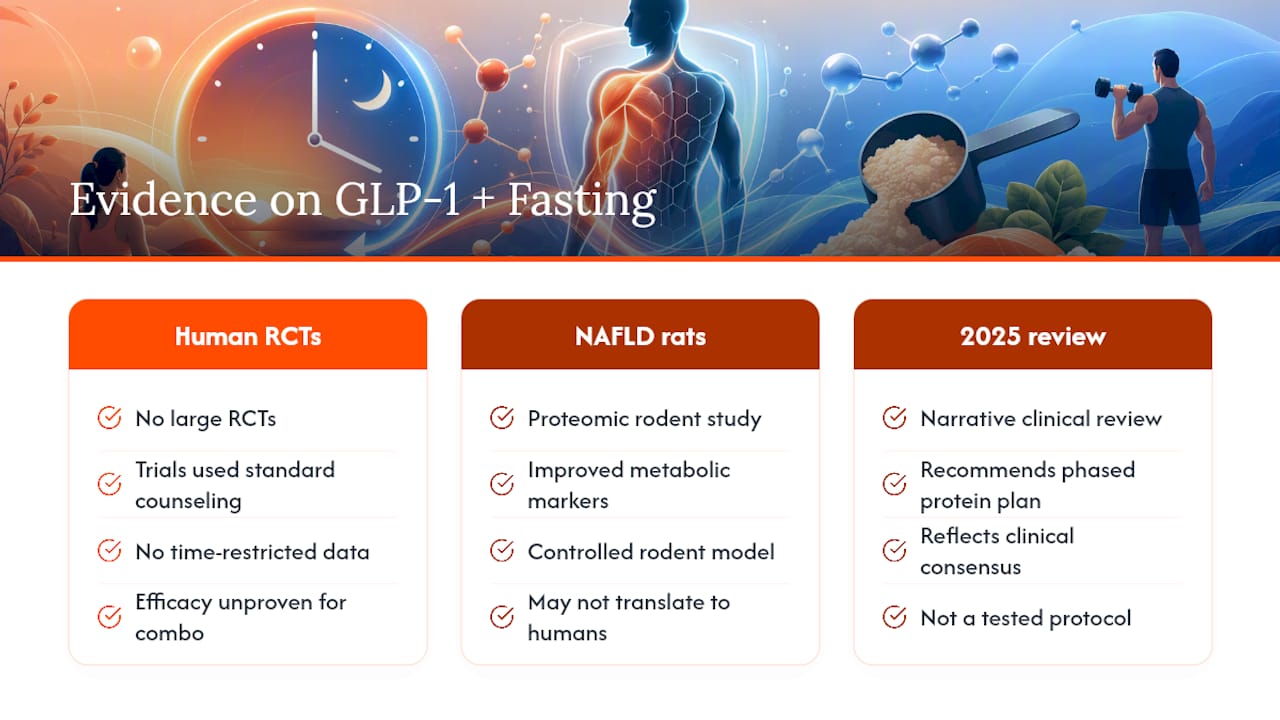
Here’s the honest answer: nobody has run a large randomized controlled trial testing GLP-1 medication plus structured intermittent fasting against GLP-1 alone. The major GLP-1 trials that produced 15 to 22% weight loss used standard dietary counseling protocols, not time-restricted eating windows. That gap in the data is the single most important thing to understand before you build a routine around this combination.
What exists instead is a mix of mechanistic reasoning, animal work, and clinical commentary. A proteomic study in NAFLD rat models found that combining intermittent fasting with a GLP-1 receptor agonist improved certain metabolic markers beyond what either intervention did alone. That’s a real signal in a controlled rodent model, not evidence that the same additive effect happens in a human liver. Animal proteomic data almost never translate one-to-one, and the study’s own authors flag that limitation.
On the clinical side, a 2025 narrative review lands on a specific recommendation: a phased, protein-optimized framework for anyone attempting to combine the two, rather than jumping straight into aggressive fasting on top of a new prescription. That review reflects a growing clinical consensus, not a tested protocol with outcome data behind it.
So the net takeaway is narrower than most blog posts admit. Combining GLP-1 and intermittent fasting is biologically plausible as a way to compound fat oxidation and appetite control. It is not proven to outperform GLP-1 therapy alone for actual weight-loss outcomes. Given that gap, safety guidance, not efficacy hype, should drive how you approach it.
Who Should Not Combine GLP-1 and Fasting Without Medical Supervision
Some combinations of medication, health history, and fasting length carry real risk, not theoretical risk. Knowing which situation you’re in changes the entire conversation with your prescriber.
The biggest one: hypoglycemia risk on insulin or a sulfonylurea. GLP-1 alone rarely causes low blood sugar because its insulin-boosting effect is glucose-dependent. Add insulin or a sulfonylurea, which push insulin release regardless of glucose level, and a fasting window removes your normal buffer of incoming carbohydrate. Clinician-facing guidance is explicit that this combination needs close glucose monitoring and often a dose adjustment before any fasting attempt.
Beyond that, a handful of other groups face elevated risk:
Dehydration and kidney stress, especially if GI side effects like nausea or vomiting are already limiting fluid intake, since fasting removes the water you’d normally get from food.
Accelerated muscle loss if protein targets go unmet during a fasting window layered on top of appetite-suppressing medication.
Older adults, who lose lean mass faster under caloric restriction and have less physiologic reserve for dehydration.
Anyone with a history of disordered eating, where structured fasting rules can reinforce restrictive patterns.
Pregnancy, breastfeeding, or major comorbidities (significant kidney or liver disease, recent GI surgery), where fasting is generally not appropriate regardless of GLP-1 use.
Pro Tip: If you’re on insulin or a sulfonylurea and want to try fasting, don’t experiment first and call your doctor later. Get the dose conversation done before you skip a meal, not after a low blood sugar scare.
How to Try Intermittent Fasting Safely on GLP-1
The goal here isn’t the longest fast you can survive. It’s a schedule your body and your medication can actually tolerate for months, not days.
1. Wait until your dose is stable. Don’t start formal fasting during dose titration. Nausea and appetite suppression peak in the first four to eight weeks after a dose increase, which makes hitting protein targets nearly impossible and masks whether symptoms are from the medication or the fast. Clinical guidance on Ozempic and fasting recommends pausing structured fasting entirely until you’re on a maintenance dose.
2. Start with 12:12, not 16:8. A twelve-hour eating window paired with twelve hours overnight is barely a stretch for most people, which makes it a genuinely low-risk starting point. Only progress to 16:8 once you’ve gone at least two weeks without dizziness, GI flares, or trouble hitting your protein goal. Avoid 24-hour or multi-day fasts unless you’re doing it under direct medical oversight. Clinician-facing resources consistently point to these shorter windows as the appropriate starting point for anyone on a GLP-1 drug.
3. Hit your protein number every day. Aim for 1.2 to 1.6 grams of protein per kilogram of body weight, which for a 70 kg adult should aim for about 1.2 to 1.6 grams of protein per kilogram of body weight daily, which supports lean mass preservation. Inside a compressed eating window, that means front-loading protein: 25 to 40 grams at the first meal, protein-first plating before carbs or fat, and a shake as backup if appetite suppression makes solid food unappealing. A tool like ForgeFast’s nutrient timing tracking can help you see whether you’re actually closing the gap or just assuming you are.
4. Treat hydration and electrolytes as non-negotiable. Sip water consistently through your fasting window rather than chugging it in one sitting, and add electrolytes (sodium, potassium, magnesium) if you notice headaches, cramping, or lightheadedness.
5. Train, don’t just diet. Resistance training twice weekly helps preserve the lean mass that both fasting and GLP-1 medication tend to erode. Schedule sessions near the end of your eating window so you can refuel immediately afterward, which supports recovery better than training fasted and hoping for the best. If you’re weighing cardio formats around a compressed schedule, this comparison of HIIT, LISS, and MISS training is a useful reference for fitting movement into a smaller window without burning out.

6. Coordinate every medication decision with your prescriber. Your weekly GLP-1 injection continues on schedule regardless of what your fasting window looks like. Insulin or sulfonylurea timing, on the other hand, has to be re-planned around your new eating pattern, and that conversation belongs with your clinician, not a fasting app.
Pro Tip: If day one of 16:8 leaves you shaky or lightheaded, that’s your body telling you to drop back to 12:12 for another two weeks. Progression isn’t a race, and backing off is not failure.
Monitoring Checklist: When to Stop or Call Your Doctor
Know your stop signs before you need them, because a fasting window is a bad time to be figuring out whether a symptom is serious.
Stop immediately and seek care for any of the following:
Fainting or near-fainting (syncope)
Persistent vomiting that prevents fluid or food intake
Severe or worsening dizziness
Confusion or unusual disorientation
Chest pain of any kind
On the tracking side, a few objective numbers tell you more than how you feel in the moment. If you have diabetes, check blood glucose on your normal schedule, not just when you feel off. Log daily protein intake for at least the first month, since most people underestimate the gap between their target and what they’re actually eating. Track total daily fluid intake, and if you have any kidney risk factors, ask your clinician about periodic labs.
When you bring this data to an appointment, be specific: report your actual eating window, your average daily protein, any symptoms with timing, and your glucose readings if applicable. Clinicians commonly respond by adjusting the GLP-1 titration schedule, modifying insulin or sulfonylurea dosing, or recommending you shorten your fasting window back to 12:12 for a few more weeks before trying again.
The ForgeFast Take on Fasting While Medicated
Most advice about GLP-1 and fasting treats the two as a math problem: less food in, more fat out. That framing misses what actually determines whether this works for six months instead of six days.
ForgeFast treats intermittent fasting as a habit system first, not a restriction protocol. The mental side, staying consistent when GLP-1 already dulls your appetite cues, matters as much as the biology. That’s exactly the situation where people overshoot: hunger goes quiet, so the eating window gets skipped entirely, protein targets slip, and lean mass pays the price. A structured framework that tracks protein, hydration, and fasting windows against a realistic weekly rhythm catches that drift before it becomes a pattern.
The ForgeFast fasting schedules resource breaks down 12:12 and 16:8 progressions for people with demanding jobs and unpredictable days, and the broader habit-resilience guide covers the mental-clarity side of sustaining a fasting pattern once the novelty wears off.
If you’re on a GLP-1 medication and want to try this: talk to your prescriber first, confirm your dose is stable, and then build a plan around protein and hydration rather than the clock. ForgeFast’s structured programs are built for exactly that phase, once you’re cleared and ready to make it sustainable instead of another short-lived attempt.
Why the “Just Fast Less” Advice Misses the Point
Most coverage of GLP-1 and intermittent fasting either oversells the combination as a metabolic hack or scares people off entirely. Neither take holds up once you look at what’s actually happening physiologically.
The overlooked issue isn’t whether fasting and GLP-1 “work together,” it’s that GLP-1 changes how reliable your own hunger signals are as a safety check. Traditional fasting advice assumes you’ll feel warning signs before things go wrong: shakiness, sharp hunger, irritability. GLP-1 flattens those signals on purpose, that’s the appetite suppression doing its job, which means the usual internal alarm system is partially disabled right when you’re adding another variable that stresses glucose and hydration. That’s not a reason to avoid combining them. It’s a reason to replace subjective feel with objective tracking, which is precisely where most people skip a step.
The other underappreciated point: the evidence gap here isn’t a minor asterisk, it’s the whole story. There is no trial showing that fasting plus GLP-1 beats GLP-1 alone for fat loss. People chasing an “additive effect” that hasn’t been demonstrated in humans risk real downsides, like accelerated muscle loss or dehydration, for a benefit that currently lives only in rat studies and expert extrapolation. If you’re going to combine the two, do it for the practical reason that a gentle eating window can make daily structure easier, not because you’re betting on unproven synergy.
The people who do this well tend to share one habit: they treat protein and hydration numbers as fixed obligations, not aspirations. Everyone else treats them as afterthoughts, and that’s usually where the muscle loss and the dizzy spells come from.
— Tony Lindsay
This article is general information, not a substitute for advice from a qualified doctor. Consult a qualified healthcare professional about your own circumstances before acting on anything here.
Sources
Recommended
Comments