Improve Decision Making Through Fasting: A Pro Guide


Fasting is a validated tool for improving decision making through fasting by directly influencing brain chemistry, mood, and cognitive clarity. Research links intermittent fasting protocols to reduced anxiety, lower depression scores, and better quality of life, all of which shape how clearly and quickly you think. The physiological mechanisms behind this include increased brain-derived neurotrophic factor (BDNF), reduced neuroinflammation, and a metabolic shift toward ketone-based brain fuel. These are not theoretical benefits. They are measurable changes in how your brain operates under a structured fasting protocol. ForgeFast is built on exactly this science, integrating the mental and physical dimensions of fasting into one disciplined framework.
What does science say about fasting and decision making?
The evidence connecting fasting to sharper cognition is more specific than most people realize. A prospective cohort study of 336 adults found that four weeks of dawn-to-dusk fasting produced statistically significant reductions in PHQ-9 depression scores and GAD-7 anxiety scores, alongside measurable quality-of-life improvements. Lower anxiety and depression directly reduce cognitive load, freeing up mental bandwidth for clearer judgment.
A large-scale review of fasting research found no meaningful cognitive decline in healthy adults during fasting periods when food cues were absent. That finding overturns the common assumption that skipping meals automatically dulls your thinking. The key qualifier is “healthy adults.” Children and adolescents showed decreased performance on cognitive tests when meals were skipped, so the cognitive benefits of fasting are age-dependent.
“Intermittent fasting’s neuroprotective effects come from modulating brain inflammation and boosting neuroplasticity rather than producing an immediate ‘clarity’ boost. The benefits build over time, not overnight.”
At the neurobiological level, intermittent fasting downregulates pro-inflammatory cytokines such as TNF-α and IL-6 while simultaneously increasing BDNF. BDNF supports the growth and maintenance of neurons, which means fasting actively supports the brain structures responsible for learning, memory, and executive function.
Mechanism | Effect on cognition |
Increased BDNF | Supports neuron growth and memory consolidation |
Reduced TNF-α and IL-6 | Lowers neuroinflammation, improving signal clarity |
Metabolic switch to ketones | Provides steady brain fuel during glucose dips |
Lower anxiety and depression | Reduces cognitive load, sharpens focus |
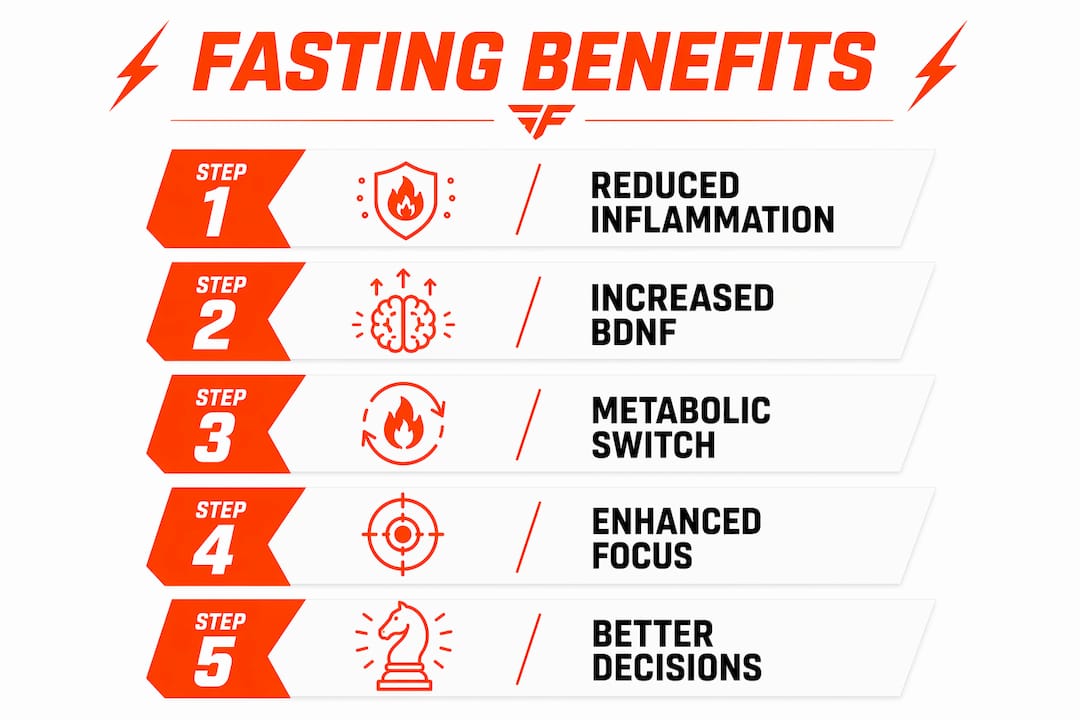
How fasting enhances focus and mental clarity
The metabolic switch from glucose to ketones is the most direct explanation for why fasting improves mental clarity. Ketones provide a more stable energy source for the brain than glucose, which spikes and crashes with each meal. The brain adapts to this fuel source gradually, typically over several weeks of consistent fasting, so immediate clarity boosts are not guaranteed on day one.

Beyond fuel, fasting reduces the constant mental noise created by food-related decisions. When you are not thinking about what to eat next, your prefrontal cortex has more capacity for the decisions that actually matter. This is not a small effect. Exposure to food cues during fasting actively shifts cognitive resources toward food-seeking behavior, which pulls focus away from complex, non-food tasks.
Key factors that determine how well fasting sharpens your focus:
Circadian alignment. Cognitive performance drops later in the day during a fast due to natural circadian rhythm dips. Schedule your most demanding decisions for the morning or early afternoon.
BDNF and inflammation. Fasting increases BDNF and reduces inflammatory markers over time, supporting mood regulation and attention in ways that compound with consistent practice.
Food cue exposure. Working near food, browsing menus, or attending catered meetings while fasting pulls cognitive resources toward hunger and away from the task at hand.
Individual variability. Age, body composition, and baseline metabolic health all influence how quickly and strongly fasting affects your mental performance.
Fasting duration. Short fasting periods improve clarity for many people, while prolonged fasting can impair cognition. Personalization is not optional.
Pro Tip: Build your fasting schedule around your most cognitively demanding work. If your peak mental energy is between 9:00 AM and noon, protect that window from food-related distractions and use it for high-stakes decisions.
These mental clarity habits backed by fasting science compound over time. The professionals who see the strongest results treat fasting as a daily cognitive practice, not a periodic diet experiment.
How to implement fasting protocols for better decisions
Starting a fasting protocol with cognitive performance as the goal requires more precision than starting one for weight loss alone. The method you choose, the timing of your eating window, and what you eat all shape how your brain performs.
Choose a protocol that fits your schedule. Time-restricted eating (typically a 16:8 window) is the most practical starting point for busy professionals. Dawn-to-dusk fasting works well for those with structured daily routines. The right fasting schedule depends on your work demands, sleep timing, and social obligations.
Prioritize hydration throughout the fast. Dehydration impairs attention and working memory faster than hunger does. Water, black coffee, and plain tea are the standard tools for maintaining cognitive performance during a fast.
Make your eating window count nutritionally. Fasting combined with a nutrient-dense diet supports mental clarity far better than fasting alone. Prioritize protein, healthy fats, and complex carbohydrates to fuel the next fasting window.
Schedule decisions during your cognitive peak. Performance drops late in the day during a fast due to circadian rhythm dips. Front-load your most complex decisions and creative work to the first half of your day.
Allow weeks, not days, for adaptation. The brain’s metabolic switch to ketones takes time. Professionals who quit after one week of foggy mornings miss the window where the real cognitive benefits begin.
Avoid common mistakes that undermine performance. Breaking a fast with high-sugar foods, fasting during high-stress periods without preparation, or ignoring sleep quality all cancel out the cognitive gains. The most frequent fasting mistakes professionals make are avoidable with a structured approach.
Pro Tip: Track your decision quality, not just your fasting hours. Keep a brief daily log of your mental sharpness, mood, and focus. After two to three weeks, patterns will emerge that tell you exactly when your cognitive peak occurs.
Fasting’s effect on motivation adds another layer to consider. Research shows that an energy deficit from fasting increases overall motivation to expend effort across domains, even while raising impulsivity specifically for food rewards. That means fasting can make you more driven and goal-oriented, as long as you manage hunger cues carefully.
Troubleshooting common fasting challenges
Most people who struggle with fasting for cognitive performance hit the same predictable obstacles. Identifying them early prevents the kind of inconsistency that erases the neurological benefits before they take hold.
Hunger distraction is the most immediate barrier. When food cues are present, the brain redirects executive function toward food-seeking. The fix is environmental: remove food from your workspace, avoid food-related media during fasting hours, and work in spaces where eating is not the norm.
Afternoon energy dips are a circadian reality, not a fasting failure. The solution is scheduling, not breaking the fast. Move low-stakes administrative tasks to the afternoon and protect mornings for decisions that require full cognitive capacity.
Inconsistent focus across weeks signals that your fasting window or eating window needs adjustment. Consider these comparison points when evaluating your protocol:
Challenge | Likely cause | Adjustment |
Morning brain fog | Adaptation phase, insufficient sleep | Extend adaptation period, prioritize sleep |
Afternoon crashes | Circadian dip plus energy deficit | Shift decision tasks to morning |
Hunger-driven distraction | Food cue exposure | Control environment, reduce cue exposure |
Irritability or poor judgment | Prolonged fast, low electrolytes | Shorten fasting window, add electrolytes |
No improvement after weeks | Protocol mismatch or poor diet quality | Reassess eating window nutrition |
Balancing fasting with professional demands requires flexibility. High-pressure days with back-to-back meetings are not ideal days to extend your fast. Fasting is a tool, not a rule. The neurological benefits of intermittent fasting accumulate through consistency over months, not through rigid adherence on the worst possible days.
Key Takeaways
Fasting improves decision making by reducing neuroinflammation, increasing BDNF, and shifting the brain to ketone-based fuel, but these benefits require weeks of consistent practice and careful protocol design to fully materialize.
Point | Details |
Fasting reduces anxiety and depression | Four weeks of structured fasting produces measurable reductions in PHQ-9 and GAD-7 scores. |
Cognitive function is preserved in adults | Healthy adults show no meaningful cognitive decline during fasting when food cues are absent. |
BDNF and inflammation are the key mechanisms | Fasting increases BDNF and lowers TNF-α and IL-6, directly supporting brain health over time. |
Timing decisions to your cognitive peak matters | Scheduling complex tasks in the morning maximizes fasting’s cognitive benefits before circadian dips hit. |
Personalization is non-negotiable | Short fasts help most people; prolonged fasting can impair cognition, so individual adjustment is required. |
Fasting and decision making: what I’ve actually learned
The research on fasting and cognition is solid, but it tells a cleaner story than real life does. What I’ve found after years of working with fasting as a cognitive practice is that the first two weeks are almost universally rough. People expect a clarity boost and get brain fog instead. That gap between expectation and experience is where most people quit, and it’s the exact wrong moment to stop.
The metabolic adaptation to ketones is real, but it is slow. The professionals who stick with a structured fasting protocol past the three-week mark consistently report a qualitative shift in how they think. Decisions feel less reactive. Mornings feel sharper. That is not placebo. It maps directly to what the neuroscience shows about BDNF and reduced neuroinflammation building over time.
My honest caution is this: fasting is not a productivity hack. Treating it like one leads to rigid, counterproductive behavior on the days when flexibility matters most. The people who get the most out of fasting are those who treat it as one component of a broader daily structure that includes sleep, nutrition quality, and stress management. Fasting alone, layered on top of poor sleep and a bad diet, produces nothing useful for your decision-making.
The fasting support for stress management angle is also underrated. Anxiety is one of the biggest silent killers of good judgment. If fasting measurably reduces anxiety scores over four weeks, that alone justifies the practice for anyone who makes high-stakes decisions regularly.
— Tony Lindsay
How ForgeFast supports your cognitive fasting practice
ForgeFast is built for people who want fasting to do more than change their body weight. The ForgeFast method integrates intermittent fasting with a structured mental framework, addressing the psychological and biological dimensions of fasting together.

The method draws on the same science covered here, including BDNF upregulation, circadian alignment, and metabolic flexibility, and translates it into a daily practice that fits a professional schedule. ForgeFast is not a generic diet program. It is a structured system designed to build the kind of consistent habits that produce lasting cognitive and physical results. If you are ready to put the science into practice, the ForgeFast app gives you the tracking tools and guided protocols to do it right from day one.
FAQ
Does fasting actually improve decision making?
Fasting improves decision making by reducing anxiety, lowering neuroinflammation, and increasing BDNF, all of which support clearer thinking and better judgment. These benefits build over several weeks of consistent practice, not immediately.
How long does it take to see cognitive benefits from fasting?
The brain’s metabolic switch to ketones takes time, typically several weeks of consistent fasting, before cognitive benefits become noticeable. Expecting results in the first few days leads to premature abandonment of the protocol.
What is the best fasting method for mental clarity?
Time-restricted eating with a 16:8 window is the most practical starting point for mental clarity, especially when the eating window is timed to end before the late-afternoon circadian dip. Pairing fasting with a nutrient-dense diet and consistent hydration produces the strongest results.
Can fasting impair cognitive performance?
Fasting can impair cognition in children, adolescents, and anyone exposed to frequent food cues during the fast. Prolonged fasting also carries cognitive risks. Short, structured fasting periods in healthy adults generally preserve or improve cognitive performance.
When should I schedule important decisions while fasting?
Schedule high-stakes decisions and complex cognitive tasks in the morning or early afternoon. Cognitive performance drops later in the day during a fast due to natural circadian rhythm dips, making afternoon the worst time for demanding mental work.
Recommended
Comments