Why Fad Diets Fail Long Term — and What Actually Works


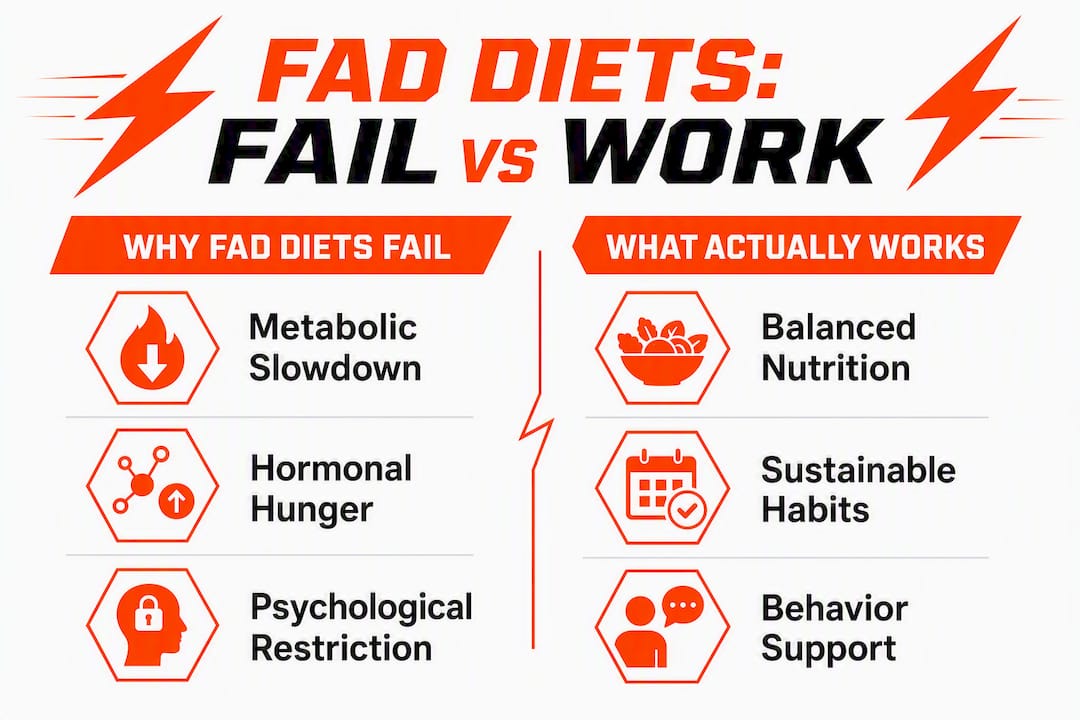
Fad diets fail long term because the body and brain fight back in ways no amount of willpower can override. The moment you slash calories drastically, predictable biological and psychological mechanisms kick in: your metabolism slows, hunger hormones surge, lean muscle erodes, and the mental strain of rigid food rules sets up a rebound cycle that often leaves you heavier than when you started.
The core failure mechanisms, backed by research from sources including Keck Medicine of USC and The Conversation, break down like this:
Metabolic adaptation: Severe calorie restriction lowers resting energy expenditure, meaning your body burns fewer calories even at rest.
Hormonal hunger rebound: Ghrelin rises and satiety hormones fall during prolonged restriction, driving intense overeating once the diet ends.
Lean muscle loss: Rapid weight loss strips away muscle alongside fat, further reducing metabolic rate and raising relapse risk.
Restriction psychology: Rigid food rules intensify cravings for banned foods, fuel guilt-driven binge cycles, and erode internal hunger cues.
Nutrient gaps: Cutting entire food groups creates micronutrient deficiencies that compound health risks over time.
Marketing and social pressure: Simplified promises, influencer testimonials, and the emotional pull of fast results keep people cycling back to the same failed approaches.
Understanding these mechanisms is the first step toward choosing something that actually holds.
Table of Contents
1. How your biology fights back against extreme diets
Metabolic adaptation starts faster than most people expect. Within days of a steep calorie deficit, the body begins reducing its resting energy expenditure, essentially turning down the thermostat to conserve fuel. This is not a character flaw or a lack of discipline. It is a survival response hardwired over hundreds of thousands of years.
A significant part of that metabolic slowdown comes from lean muscle loss during rapid weight loss. Crash diets rarely strip pure fat. They pull water, glycogen, and lean tissue too, and since muscle is metabolically expensive to maintain, losing it means your body needs fewer calories to function. The result: the same meal that once maintained your weight now creates a surplus.
The hormonal picture makes things worse. Prolonged caloric restriction increases ghrelin and suppresses satiety hormones, creating what clinicians call a “hunger rebound.” Once the diet ends or even loosens slightly, appetite spikes well above baseline. People often describe eating past fullness without meaning to. That is not weakness. That is biology correcting a deficit.
Statistic callout: Research reviewed by The Conversation reports that people typically regain 50–70% of lost weight in the months to years following a crash diet, largely because of these compounding metabolic and hormonal shifts.
Understanding metabolic flexibility — your body’s ability to switch between fuel sources efficiently — helps explain why protecting lean mass and metabolic rate matters so much more than the number on the scale during any given week.
2. Why restrictive rules drive rebound eating
The psychological side of fad diet failure is just as predictable as the biological side. Restrictive diets create a cognitive pattern where banned foods become more desirable, not less. Psychological research shows that cutting high-reward foods intensifies cravings and reduces long-term adherence, often triggering the exact overeating the diet was meant to prevent.

The cycle looks like this: strict rules create a sense of deprivation, deprivation amplifies craving, one slip triggers guilt, guilt produces an “I’ve already blown it” mindset, and that mindset opens the door to a full binge. Psychologists call this the “what-the-hell effect,” and it is one of the most consistent findings in dietary behavior research.
Beyond cravings, rigid dieting blunts internal hunger and satiety cues over time. When you eat by a rulebook rather than by body signals, you gradually lose the ability to recognize genuine hunger versus emotional hunger. Dietitians and psychologists report that this restriction mentality increases anxiety and guilt and makes flexible, lasting eating patterns harder to restore after the diet ends.
There is also the identity trap. Some people build their sense of discipline and self-worth around following a specific protocol. When the protocol becomes unsustainable, the failure feels personal rather than structural, which deepens shame and reduces the likelihood of trying a more sensible approach.
Common psychological warning signs that a diet is setting you up for rebound:
Thinking about food constantly, even when not physically hungry
Feeling intense guilt after eating anything “off plan”
Avoiding social situations because of food anxiety
Swinging between extreme restriction and uncontrolled eating
Tying your self-worth to the number on the scale
Pro Tip: When you notice the “I’ve already blown it” thought after one unplanned meal, treat it as a signal to pause rather than continue eating. Write down what triggered the slip, eat a normal next meal, and move on. The psychology of controlled hunger research consistently shows that recovery speed matters far more than perfection.
3. Nutritional risks you probably haven’t been told about
Fad diets do not just fail to deliver lasting results. Many of them actively harm health in ways that compound over time. The most immediate risks come from cutting entire food groups.
Very-low-carb plans often create fiber shortfalls, which disrupt gut microbiome diversity and raise cardiovascular risk markers. Strict vegan protocols without supplementation carry vitamin B12 deficiency risk. Protein-sparing modified fasts can cause electrolyte imbalances serious enough to affect heart rhythm. These are not rare edge cases. They are predictable consequences of exclusionary eating.
Key nutritional risks linked to common fad approaches:
Micronutrient deficiencies: Iron, calcium, zinc, and B vitamins are frequently depleted on exclusionary plans.
Electrolyte imbalances: Very-low-calorie and very-low-carb diets can cause sodium, potassium, and magnesium losses.
Kidney stone risk: High-protein, low-fluid protocols raise urinary calcium and oxalate levels.
Reduced protein intake: Paradoxically, some fad plans that emphasize “clean eating” under-deliver on protein, accelerating muscle loss.
Bone density concerns: Prolonged calorie restriction without adequate calcium and vitamin D can reduce bone mineral density over time.
Clinical guidance from Keck Medicine warns that very-low-calorie diets can be dangerous and should only be followed under medical supervision, particularly for postpartum women, older adults, and anyone with a pre-existing metabolic condition.
The longer-term picture is grimmer still. Repeated short-term diets create a weight-cycling pattern associated with elevated disease risk and higher mortality in some observational studies. Each cycle of loss and regain tends to shift body composition toward a higher fat-to-muscle ratio, making the next attempt harder and the metabolic consequences more pronounced.
4. What longitudinal studies actually show about weight regain
The research on long-term diet outcomes is consistent enough to be uncomfortable. Most people who lose weight through restrictive dieting regain a substantial portion within one to two years. The Conversation’s review of nutrition and psychology literature puts typical regain at 50–70% of lost mass after standard dieting attempts.
Study / Source | Design | Key Finding |
Harvard Health review | Longitudinal review | Most dieters regain lost weight within months; sustained loss is the exception, not the rule |
The Conversation (nutrition/psychology review) | Literature review | 50–70% of lost weight typically regained after crash dieting |
Keck Medicine of USC clinical summary | Clinical review | Weight cycling linked to elevated disease risk and worse long-term health markers |
OHSU Women’s Health | Clinical guidance | Restriction mentality erodes internal hunger cues, making lasting flexible eating harder to restore |
PMC / Frontiers in Nutrition | Systematic review | Fad diets appealing due to proposed claims but lack scientific support for long-term outcomes |
A few important caveats about this literature. Most diet studies run 6–12 months, which is too short to capture the full regain trajectory. “Fad diet” is not a standardized clinical term, so study populations vary widely. And publication bias means studies showing dramatic short-term results get more attention than the follow-up data showing regain.
What the strongest signals show, across multiple reviews:
Short-term weight loss is achievable on almost any calorie-restricted plan.
Maintenance beyond two years is rare without behavioral and lifestyle change.
The type of diet matters less than whether it can be sustained without misery.
Approaches that preserve lean mass and support metabolic health produce better long-term outcomes than those that prioritize speed.
Harvard Health’s review notes that at any given time, more than a third of Americans are on a specific diet, with weight loss as the leading reason. Most will be disappointed, because even when successful, lost weight is frequently regained within a few months.
5. Why fad diet marketing is so hard to resist
The science against fad diets is not hidden. It is published in major journals, summarized by the American Heart Association, and repeated by registered dietitians across the country. Yet the fad diet industry keeps growing. That gap between evidence and behavior is not a mystery. It is the product of very effective marketing.
The American Heart Association reports that people who follow fad diets often overestimate their own nutritional knowledge and favor anecdotal evidence over stronger scientific guidance. Agricultural economist Christopher Gustafson describes this as substituting perceived knowledge for actual expertise after “self-research,” which leads people toward diets that feel like answers but lack evidence.
Charlotte Markey, a psychology researcher at Rutgers, puts it plainly: fad diets rely on oversimplified, emotionally appealing marketing that promises fast results, while sustainable change requires slower, harder habit work. The emotional appeal of a clear, fast solution is genuinely difficult to resist, especially when you are frustrated with your current situation.
The marketing playbook for fad diets follows a predictable pattern:
Speed promises: “Lose 10 pounds in 10 days” activates urgency and bypasses critical evaluation.
Required product purchases: Proprietary supplements, meal replacements, or branded foods create financial commitment that feels like investment.
Vague scientific language: Terms like “detox,” “alkaline,” or “metabolic reset” sound credible without making falsifiable claims.
Selective anecdotes: Before-and-after photos and influencer testimonials are real but unrepresentative. They show the best-case outcome, not the median.
Community belonging: Online groups and challenges create social identity around the diet, making it harder to quit without feeling like you are abandoning a tribe.
The American Heart Association and FTC consumer guidance both flag these patterns as warning signs. Recognizing them does not make you immune to them, but it does give you a moment to pause before buying in.
6. Evidence-based alternatives that actually hold up over time
The good news is that the research pointing out fad diet failures also points clearly toward what works. Approaches that prioritize metabolic protection, nutrient adequacy, and sustainable behavior change consistently outperform quick-fix protocols in long-term outcomes.

Dietetic associations and public-health guidance favor balanced, nutrient-dense eating patterns with activity and behavior change over extreme restriction. The Mediterranean and DASH eating patterns have the strongest long-term evidence base, not because they are magic, but because they are sustainable, nutritionally complete, and do not require eliminating entire food groups.
Approach | Core principle | Long-term evidence | Metabolic protection |
Mediterranean-style eating | Whole foods, healthy fats, variety | Strong; associated with reduced cardiovascular risk | High — preserves lean mass when combined with adequate protein |
DASH eating pattern | Low sodium, high potassium, balanced macros | Strong; designed for blood pressure management | Moderate to high |
Balanced energy restriction with protein focus | Moderate deficit, 1.2–1.6 g protein/kg body weight | Good; reduces lean mass loss during deficit | High when paired with resistance training |
Extreme low-calorie fad diet | Severe restriction, often food-group exclusion | Poor; high regain rates, nutrient gaps | Low — accelerates muscle loss |
What makes an approach durable comes down to a few consistent principles:
Fiber from whole foods: — Vegetables, legumes, and whole grains support gut health and reduce hunger between meals.
Realistic timeline expectations matter too. A sustainable rate of fat loss sits around 0.5–1% of body weight per week for most people. At that pace, a 180-pound person loses roughly 0.9–1.8 pounds per week. That feels slow compared to a crash diet’s first-week number, but it is almost entirely fat rather than muscle and water, and it is far more likely to stay off.
Comparing fasting-based approaches with detox-style programs shows a similar pattern: structured protocols with behavioral frameworks outperform short-term cleanses on every meaningful long-term metric.
7. How to actually move off a fad diet, step by step
A gradual, habit-based approach with realistic targets is the most reliable path off a fad diet. The goal is not to swing from extreme restriction to unrestricted eating. It is to rebuild a relationship with food that your body and brain can sustain indefinitely.
Here is a practical transition sequence:
Stop the restriction cold turkey, not the food. End the fad protocol, but do not immediately eat everything you have been avoiding. Reintroduce foods one category at a time over one to two weeks to avoid the hormonal surge that drives binge eating.
Set a calorie floor, not just a ceiling. Eating too little is the problem you are solving. Aim for a modest deficit of 300–500 calories below your total daily energy expenditure, not the 800–1,200 calorie floors common in fad plans.
Prioritize protein at every meal. Add a palm-sized protein source to breakfast, lunch, and dinner before changing anything else. This single habit protects lean mass and reduces hunger more reliably than most other dietary changes.
Add resistance training early. Two sessions per week of compound movements (squats, rows, presses) during the first four weeks of transition signals the body to preserve muscle even in a mild deficit. Building habits that last requires anchoring new behaviors to existing routines, and strength training is one of the highest-leverage anchors available.
Track behavior, not just weight. Log meals eaten, protein targets hit, and workouts completed. The scale will fluctuate for weeks as water balance normalizes after a fad diet. Behavior metrics give you real signal during that noisy period.
Plan for setbacks explicitly. Write down in advance what you will do after an unplanned high-calorie day or a missed workout week. People who pre-plan their recovery response return to baseline faster than those who rely on willpower in the moment.
8-week transition checklist:
Weeks 1–2: Reintroduce excluded food groups gradually; hit protein targets daily
Weeks 3–4: Add two resistance training sessions per week; track meals without judgment
Weeks 5–6: Assess hunger and satiety cues; adjust calorie intake based on energy and weight trend
Weeks 7–8: Evaluate sleep, stress, and social eating patterns; identify one habit to reinforce and one to adjust
Pro Tip: Avoiding diet burnout during the transition phase often comes down to one thing: keeping the process interesting. Rotate protein sources, try one new vegetable per week, and treat the transition as an experiment rather than a test of character. Curiosity sustains behavior change longer than discipline alone.
8. When to get professional help and who to ask
Seek professional support if you have a medical condition, a history of persistent weight cycling, signs of disordered eating, or simply want personalized guidance that improves your odds of sticking with a plan. That last reason alone is sufficient. Accountability and expertise are not luxuries.
Types of professionals and what they offer:
Registered Dietitian Nutritionist (RDN): The gold standard for personalized nutrition guidance. An RDN can assess your current intake, identify deficiencies from past fad dieting, and build a realistic eating plan around your preferences and health history. Look for someone credentialed through the Academy of Nutrition and Dietetics.
Behavioral or cognitive-behavioral therapist: If restriction cycles, binge eating, food anxiety, or disordered eating patterns are present, a therapist trained in cognitive-behavioral therapy (CBT) or acceptance and commitment therapy (ACT) addresses the psychological drivers that dietitians alone cannot.
Primary care physician or endocrinologist: Rule out thyroid dysfunction, insulin resistance, polycystic ovary syndrome (PCOS), and other metabolic conditions that can make weight management genuinely harder. These are not excuses. They are real physiological variables that change the right approach.
Exercise physiologist or certified strength and conditioning specialist (CSCS): If you are new to resistance training or have joint issues or injuries, a qualified exercise professional designs a program that protects lean mass without injury risk.
Questions to ask at an initial consult:
What does your approach look like for someone coming off a restrictive diet?
How do you handle setbacks or periods of weight regain?
Do you recommend any specific products or supplements? (A red flag if the answer is yes without a clear clinical rationale.)
What does a realistic timeline look like for my situation?
How do you measure progress beyond the scale?
Red flags to walk away from:
Promises of rapid, effortless results
Mandatory purchase of proprietary supplements or meal plans
Rigid food rules with no flexibility for real life
Dismissal of mental health or behavioral factors
No interest in your medical history
Clinical guidance from Keck Medicine specifically flags unsupervised very-low-calorie diets as dangerous, which means any practitioner pushing one without thorough medical screening is a red flag in itself.
9. Expert perspectives and what practitioners actually see
The gap between what fad diets promise and what they deliver is not just a statistical abstraction. It shows up in clinical practice consistently.
Charlotte Markey, a psychology researcher at Rutgers University, notes that fad diets rely on oversimplified, emotionally appealing marketing that promises fast results, while sustainable change requires the slower, harder work of building habits. That framing matters because it shifts the question from “which diet is best?” to “which habits can I actually maintain?”
Practitioners working with people coming off fad diets report a consistent set of patterns:
Clients often arrive with a distorted sense of what a normal portion looks like, having calibrated to artificially small amounts.
Hunger cues are frequently dysregulated, making it hard to distinguish physical hunger from habit-driven eating or emotional triggers.
The first two to four weeks of transition involve water-weight fluctuation that can feel like failure even when fat loss is occurring.
People who track process goals (“I hit my protein target today,” “I completed two strength sessions this week”) recover their sense of competence faster than those tracking only weight.
Behavioral change research supports tracking process goals over outcome goals because process goals preserve a sense of competence and reduce the all-or-nothing mindset that fad dieting reinforces. ForgeFast’s habit-first framework is built around exactly this principle: structure the behavior, and the outcomes follow.
The PMC review on fad diets confirms that while these diets are appealing due to proposed claims, they lack scientific support for long-term outcomes. The evidence consistently favors approaches that combine behavioral change, metabolic protection, and nutritional adequacy over any single dietary protocol.
This article is for general informational purposes only and does not constitute medical or nutritional advice. Consult a qualified healthcare professional before making significant changes to your diet or exercise routine.
Key Takeaways
Fad diets fail long term because they trigger metabolic slowdown, hormonal hunger rebound, and psychological restriction cycles that make sustained weight loss nearly impossible without a habit-based, evidence-backed approach.
Point | Details |
Biology fights back fast | Metabolic adaptation and hormonal hunger rebound begin quickly under severe restriction, driving regain once the diet ends. |
Regain is the norm, not the exception | Research estimates a substantial portion of lost weight is typically regained after crash dieting, largely due to muscle loss and metabolic slowdown. |
Restriction creates its own cravings | Cutting high-reward foods intensifies desire for them, fueling binge-restrict cycles that erode adherence over time. |
Sustainable alternatives exist | Mediterranean-style eating, adequate protein, resistance training, and behavior tracking consistently outperform quick-fix diets on long-term outcomes. |
ForgeFast builds the habits that hold | ForgeFast’s structured intermittent fasting protocols and behavioral coaching address the psychological and metabolic drivers that fad diets ignore. |
The real problem with quick fixes
The fad diet industry keeps thriving not because people are gullible, but because the promise of a fast, clean solution to a genuinely hard problem is compelling. Anyone who has struggled with weight knows how exhausting the long game feels. A ten-day reset sounds like relief.
What the research makes clear, though, is that the speed is the problem, not the solution. Every mechanism that makes a crash diet feel effective in week one, the rapid scale drop, the sense of control, the social validation, is setting up a harder failure in month three. The body does not distinguish between a fad and a famine. It responds the same way it has for millennia: by slowing down, ramping up hunger, and holding on to every calorie it can.
The practitioners who see the best long-term outcomes are not the ones prescribing the strictest protocols. They are the ones helping people build the smallest sustainable changes and stack them over time. A 0.5% weekly loss that holds for two years beats a 10-pound crash that reverses in six weeks, every single time.
If there is one thing worth taking from all of this, it is that the goal is not a diet you can survive. It is a way of eating you never have to recover from.
ForgeFast: a structured alternative to the fad cycle
Most people who have tried and failed at fad diets are not lacking motivation. They are lacking a framework that works with their biology instead of against it.
ForgeFast is built around exactly that problem. The platform combines structured intermittent fasting protocols with behavioral coaching, habit tracking, and educational content grounded in the physiological and psychological research covered in this article. Where fad diets impose rigid food rules that erode over time, ForgeFast builds the mental and metabolic flexibility to sustain change without white-knuckling every meal.

The approach maps directly to what the evidence supports: protect lean mass, manage hunger hormonally rather than through willpower, track behavior over outcomes, and build habits that compound. There are no proprietary supplements to buy, no food groups to eliminate permanently, and no 10-day promises.
If you are ready to move past the fad cycle and build something that holds, start with ForgeFast and see how a habit-first protocol actually works in practice.
Disclosure: This section describes ForgeFast’s paid subscription platform, which is the publisher of this article.
Useful sources
When dieting doesn’t work — Harvard Health: A clinician-written review explaining why most diets fail to produce lasting results and what the evidence shows about long-term weight maintenance.
Fad Diets: Facts and Fiction — PMC / Frontiers in Nutrition: A peer-reviewed systematic review of fad diet claims, their appeal, and the lack of scientific support for long-term outcomes.
Fad Diets: Do They Work? — Keck Medicine of USC: Clinical summary covering hormonal hunger rebound, weight-cycling risks, and when very-low-calorie diets require medical supervision.
Why strict diets are a bad idea for long-term weight loss — The Conversation: Evidence-based explainer on lean muscle loss, metabolic rate reduction, and typical regain rates after crash dieting.
Research says fad diets don’t work. So why are they so popular? — American Heart Association: Reports on the marketing psychology behind fad diet popularity, including insights from Charlotte Markey and Christopher Gustafson.
Fad diets: Are they sustainable? — OHSU: Clinical perspective on how the restriction mentality erodes hunger cues and increases anxiety, making lasting flexible eating harder to restore.
Fad Diets: Why They Don’t Work — Healthline: Practical summary of nutrient deficiency risks linked to exclusionary diets, including fiber shortfalls and vitamin B12 risk.
The Health Risks of Fad Diets — Oklahoma State University Extension: Extension fact sheet covering the physiological and nutritional risks of common fad approaches, written for a general audience.
Recommended
Comments