Three Rules to Keep Fasting While Traveling for Busy Professionals


Yes, you can keep fasting while traveling, and for most trips it actually works better than trying to eat “normally” on an unpredictable schedule. The three rules that matter: match your time-zone strategy to trip length (gradual shift or immediate re-anchor), protect sleep before you protect timing, and drop to a maintenance fast of at least half a day whenever obligations pile up.
TL;DR:
For trips crossing four or more time zones, start adjusting your eating window two to three days early by one to two hours daily for smoother circadian realignment.
Packing electrolytes, protein snacks, tea or coffee, and a refillable water bottle before travel helps maintain fasting efficiency and hydration during flights.
Aim for three protein feedings of 30 to 40 grams during your eating window to preserve muscle, especially since meals during travel tend to be irregular.
Prioritize sleep recovery over strict fasting timing when dealing with travel fatigue, adjusting your fast length based on sleep quality and stress levels.
Use travel mode in fasting apps to automatically adjust your schedule, and set your re-anchor date before departure to avoid last-minute decision fatigue.
Table of Contents
How to handle time zones: gradual pre-shift vs re-anchoring to local time
In-transit tactics: what to pack and how to handle flights and airports
Nutrition and training on the road: protein, workouts, and social meals
Guidelines for safe fasting while traveling with pre-existing medical conditions
Adjusting fasting in the context of travel-related stress and sleep disruptions
ForgeFast travel workflow: set travel mode, pack your fasting kit, and keep protein on autopilot
How to handle time zones: gradual pre-shift vs re-anchoring to local time
The right approach depends almost entirely on how far you’re flying, not on willpower. Short hops across one, two, or three time zones rarely justify overhauling your eating window. A trip from New York to Denver doesn’t need a new protocol. Keep your home schedule or nudge it by an hour, and you’ll adjust within a day.
Longer trips are different. Once you’re crossing four or more time zones, your body’s internal clock and your stomach’s expectations start fighting each other, and that fight shows up as fatigue, irritability, and the kind of hunger that has nothing to do with actual energy needs.
Mayo Clinic’s travel medicine guidance addresses this directly: for trips spanning four or more zones, start shifting your eating window by one to two hours each day for two or three days before you leave. By the time you board, your body is already halfway adjusted.
If you didn’t plan ahead, the immediate method works too: fast through the flight itself and eat your first meal at the local mealtime on arrival. This re-anchors your circadian rhythm faster than gradual adjustment, though it demands more discipline in the first 24 hours.
A few situational rules help decide between the two:
Trips under 3 time zones: keep your existing window, or shift it by no more than an hour.
Trips of 4+ time zones with advance notice: start the gradual pre-shift 2 to 3 days out.
Red-eye flights or last-minute travel: skip the gradual method and fast through the flight, breaking your fast at the destination’s local dinner or breakfast time.
Severe jet lag on arrival: delay your eating window rather than force it. Sleep debt undermines fasting benefits more than a shifted meal time ever will.
Daylight exposure matters here too. Getting outside during daylight hours at your destination helps reset your circadian clock faster than diet timing alone, so pair whichever eating strategy you choose with a walk outside soon after arrival.
Pro Tip: If you’re unsure which method to use, default to the immediate re-anchor for trips longer than five days and the gradual shift for anything shorter. Short trips don’t give your body enough time to benefit from a slow transition anyway.
In-transit tactics: what to pack and how to handle flights and airports
Decision fatigue is the real enemy on travel days, not hunger. Packing the right items ahead of time means you never have to negotiate with an overpriced airport pretzel stand at 30,000 feet.
Pack these before you leave the house:
Electrolyte packets (sodium, potassium, magnesium) to prevent the headaches and fatigue that mimic hunger during a fast.
Single-serve protein powder or beef jerky for breaking your fast the moment your window opens.
Tea bags or instant black coffee, both of which are fine during a fasting window and pass through security without issue.
An empty refillable water bottle to fill after the security checkpoint.
Once you’re in transit, a few behavior rules make the fast easier to hold:
Skip the meal service if your fasting window overlaps the flight; flight attendants won’t push back if you say you’re not eating.
Sleep whenever the cabin allows it, especially on overnight flights. Rest matters more than forcing wakefulness to “power through.”
Use caffeine early in the fasting window, not right before your target sleep time at the destination.
Hydrate on a schedule, not just when thirsty. Cabin air is dry enough that mild dehydration frequently gets misread as hunger.
Practical travel tactics like fasting through flights and using black coffee strategically show up consistently in advice from people who fly often while fasting, and the pattern holds regardless of airline or route.
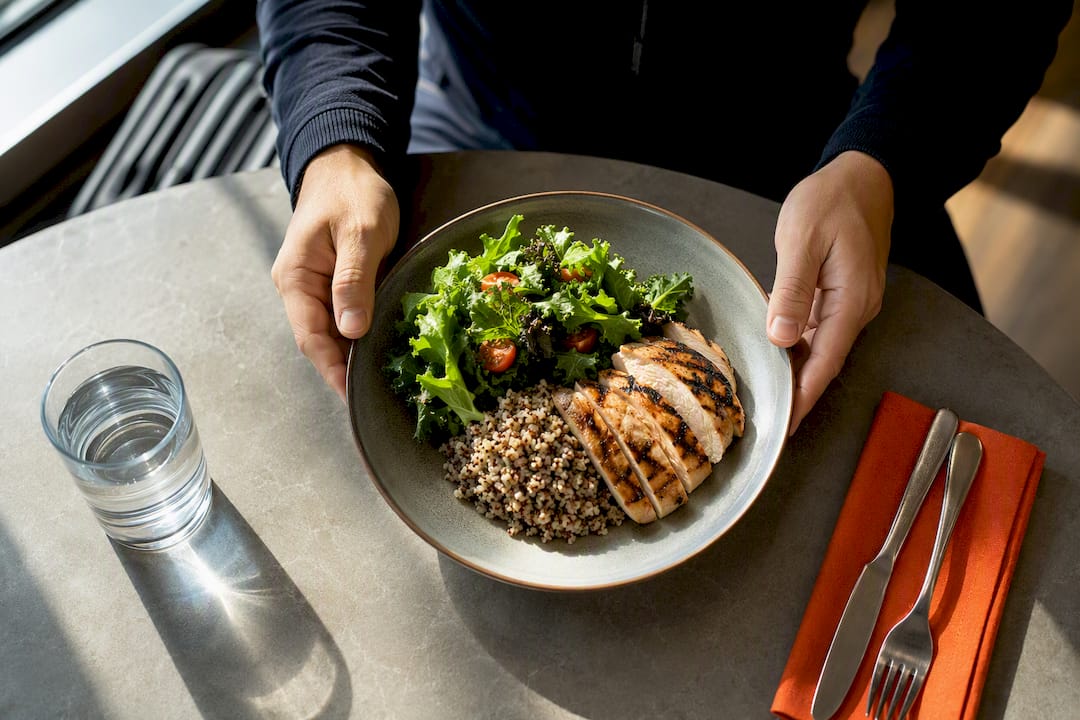
When your eating window opens inside an airport, skip the food court. Sit-down restaurants and protein-forward counters (grilled chicken, poke bowls, a proper deli sandwich) beat pretzels and candy on every metric that matters for a fast you’re trying to protect.
Nutrition and training on the road: protein, workouts, and social meals
A 16:8 window doesn’t automatically protect your muscle while you’re traveling. It protects your muscle when you hit your protein targets inside that window, and travel makes that harder because meals get irregular and portions get unpredictable.
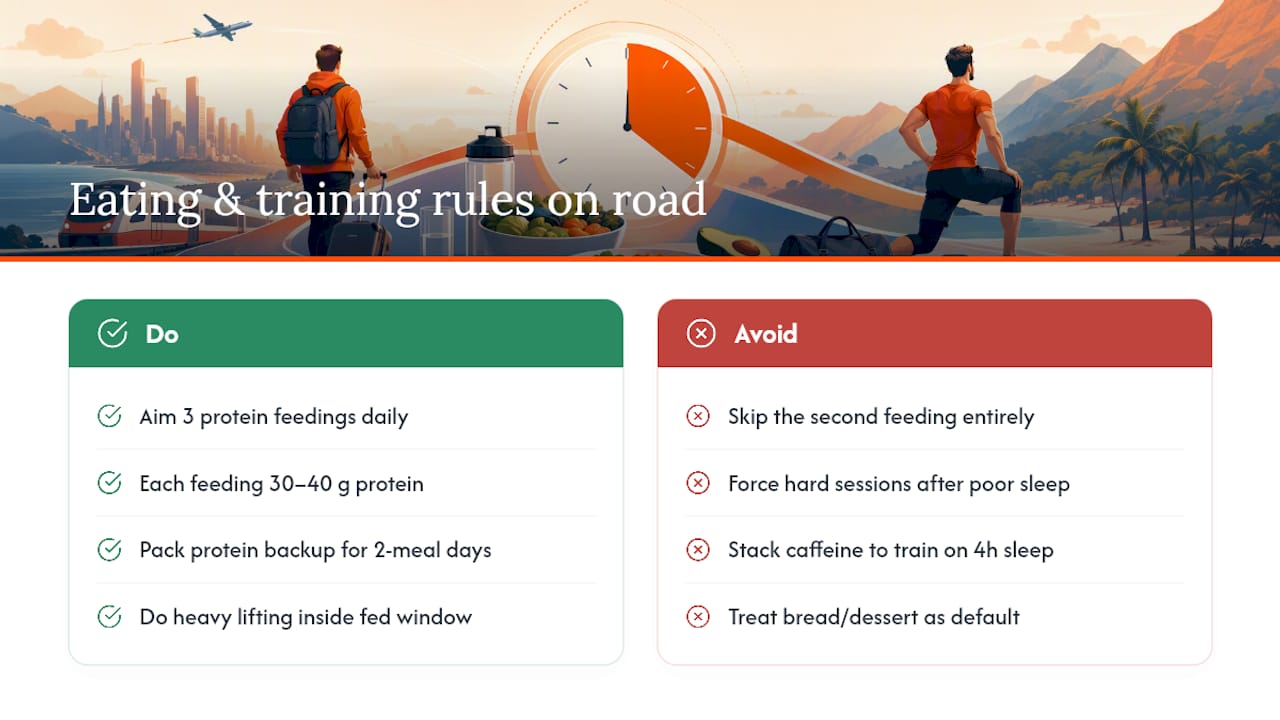
The rule from research on intermittent fasting and muscle retention is straightforward: aim for three protein feedings of 30 to 40 grams each during your eating window. If your schedule only allows two meals on a given day, treat that as a maintenance day and pack a protein backup, rather than skipping the second feeding entirely.
On the road: Three feedings of 30–40g protein beat one large meal for preserving muscle during a fasting window, according to that same source’s guidance for busy professionals managing tight schedules.
Training timing follows a similar logic. Heavy lifting belongs inside your fed window, when glycogen and amino acids are actually available to support the effort. Light movement (walking, mobility work, an easy hotel-gym session) works fine fasted. If jet lag has wrecked your sleep, skip the hard session altogether. Stacking caffeine to force a fasted workout on four hours of sleep does more damage to recovery than the workout does good.
Social meals and business dinners are where most travelers abandon their fast entirely, usually because they think it’s all or nothing. It isn’t. Shift your window later on dinner days: push your first meal to 1 or 2 PM instead of 11 AM, and you can still make an 8 PM dinner without breaking a 16 or 17 hour fast. At the table, order protein-first (grilled fish, a steak, chicken over pasta) and treat bread baskets and dessert as optional rather than default. One indulgent dinner doesn’t undo a week of consistent windows.
Guidelines for safe fasting while traveling with pre-existing medical conditions
Travel adds stress on top of whatever your body is already managing, and that changes the calculus for anyone with diabetes, a history of low blood pressure, adrenal issues, or a condition requiring medication with food. If you take medication that requires food, don’t skip it to preserve a fasting window. Adjust the fast around the medication schedule instead of the other way around.
People managing blood sugar conditions should be especially cautious about combining fasting with long flights, altitude changes, and disrupted sleep. All three can affect glucose regulation independently, and stacking them with an extended fast adds variables that are hard to predict without monitoring. If you use continuous glucose monitoring, lean on that data during travel days rather than guessing.
Pregnant travelers, anyone with a history of disordered eating, or anyone recovering from illness should treat travel as a reason to loosen the fast, not tighten it. This isn’t the week to test a longer window than you’ve done at home.
If you’re on any prescription that specifies “take with food,” “take twice daily,” or has instructions tied to meal timing, talk to your doctor about how travel and fasting interact before you go, not after you’re wheels-up over the Atlantic with a headache and no clear plan.
Adjusting fasting in the context of travel-related stress and sleep disruptions
Travel stress and sleep loss both raise cortisol, and elevated cortisol makes fasting feel harder than it would at home, even at the same window length you handle fine on a normal week. This is physiological, not a failure of discipline.
The practical response is to treat sleep recovery as the priority and let fasting timing bend around it. If you land somewhere at 2 AM local time and don’t get real sleep until noon, don’t force a 16-hour fast that started the moment you woke up groggy at 6 AM. Push your first feeding until you’ve had an actual restorative stretch of sleep, even if that means a shorter fast than usual that day.
A stressful travel week (missed connections, a redone itinerary, a hotel switch at midnight) is exactly when a rigid full protocol backfires. This is where the tiered approach earns its keep: a full 16 to 18 hour fast on calm days, a compressed 14-hour version when the schedule tightens, and a 12-hour maintenance fast on the days everything goes sideways. All three preserve most of the metabolic benefit you’re after, and none of them require you to white-knuckle through a fast while running on three hours of sleep and airport coffee.
ForgeFast travel workflow: set travel mode, pack your fasting kit, and keep protein on autopilot
Deciding your fasting strategy mid layover, with a boarding call in fifteen minutes, is exactly the kind of decision fatigue that derails otherwise solid habits. ForgeFast builds travel into the app itself instead of leaving you to recalculate everything from scratch at gate B12.

The app’s travel mode automatically adjusts your eating window based on time zones you enter, so you’re not doing mental math over a connecting flight. Travel presets let you pick gradual shift or immediate re-anchor ahead of time, protein reminders keep your three feedings on schedule even when meals get pushed around, and travel-friendly meal templates suggest protein-forward options instead of leaving you to guess at an unfamiliar airport terminal.
Getting set up before a trip takes three steps: turn on travel mode in your settings, schedule your window re-anchor date based on your itinerary, and pack your fasting kit (electrolyte packets, single-serve protein) the night before you leave. The ForgeFast platform handles the scheduling logic behind that, so the plan you set at home actually holds once you’re in a different time zone. If your travel schedule tends to repeat itself, a reusable fasting plan template built around your typical trip length saves you from rebuilding the same strategy every time you pack a bag.
Habit resilience and the right mindset for travel
Treat a travel week as a different tier of the same protocol, not a broken streak. A 12 hour maintenance fast during a chaotic trip isn’t a failure. It’s the deliberate, correct choice for that week.
Sleep outranks perfect timing every time. If you have to choose between hitting your usual 16 hours and getting real rest after a red-eye, choose rest. A fasted workout on no sleep costs you more than it gives back.
The travelers who stay consistent aren’t the ones with the most willpower. They’re the ones who set their rules before the trip starts and let a system remove the daily decisions instead of relitigating the plan at every layover.
— Tony Lindsay
Sources
Recommended
Comments