How Fasting Shapes Prefrontal Cortex Function and Your Mind
- Tony Lindsay
- Jul 22
- 9 min read


How does fasting affect the prefrontal cortex?
Fasting produces measurable, targeted changes in the prefrontal cortex (PFC), the brain region most responsible for decision-making, emotional regulation, and working memory. The role of prefrontal cortex fasting research has clarified is not passive. Fasting actively modulates neurochemical signaling there, shifting receptor activity, fuel sources, and gene expression in ways that ripple outward into mood, cognition, and behavior.
Here is what the science currently shows:
Dopamine D1 receptor activity rises in the medial prefrontal cortex (mPFC) during fasting, triggering the Drd1-cAMP-PKA-DARPP-32-CREB-BDNF signaling cascade that produces antidepressant-like effects
Serotonin 5-HT2A receptor expression in the mPFC increases during fasting, contributing to mood stabilization and reduced anxiety-like behavior
β-hydroxybutyrate (BHB), the primary ketone body produced when glucose runs low, acts as a signaling molecule that drives BDNF expression and supports synaptic plasticity
Ventromedial PFC (vmPFC) activation decreases during overnight fasting, which accelerates fear extinction and safety learning by altering reward prediction error signals
Insulin signaling increases specifically in the PFC during fasting, with elevated p-BAD(ser155) and p-AKT(ser473) phosphorylation, a pattern not seen in other brain regions
Neuroinflammation drops, reducing a key driver of depression and anxiety through PFC-mediated pathways
The picture that emerges is a brain region that fasting targets with unusual specificity, not a uniform whole-brain effect.
What neurobiological mechanisms drive fasting’s effects on the PFC?
The prefrontal cortex does not respond to fasting the way the hippocampus or hypothalamus does. Its changes are receptor-specific and pathway-driven, which is exactly why researchers find them so clinically interesting.
Dopamine D1 and the antidepressant cascade
The clearest mechanistic story involves dopamine. Intermittent fasting upregulates dopamine D1 receptors in the mPFC and activates the Drd1-cAMP-PKA-DARPP-32-CREB-BDNF pathway. When researchers blocked D1 receptors pharmacologically, the antidepressant-like behavioral outcomes disappeared. Optogenetic studies confirmed that Drd1-expressing neurons in the PFC are the central node. This is not a general dopamine story; it is a PFC-specific one.

Serotonin 5-HT2A receptor modulation
Fasting also elevates serotonin 5-HT2A receptor activity in the mPFC. Animal studies show that this receptor’s upregulation correlates with increased BDNF and c-Fos expression in prefrontal circuits, producing antidepressant effects measurable in forced-swim behavioral tests. The serotonin and dopamine pathways appear to work in parallel rather than in sequence.
BHB as a signaling molecule, not just fuel
When fasting shifts the brain from glucose to ketones, BHB does more than keep neurons energized. It acts directly on NF-κB transcription factors, increasing BDNF gene expression and triggering mitochondrial biogenesis. This is the metabolic switching mechanism: an evolutionarily conserved stress response that the PFC is particularly sensitive to.
Pro Tip: If you are practicing intermittent fasting and want to maximize the BHB-driven BDNF window, the cognitive and mood benefits tend to peak in the later hours of a fast, once ketone production is well underway, not at the start.
Region-specific insulin signaling
Fasting increases p-BAD and p-AKT phosphorylation exclusively in the PFC while decreasing these markers in the hippocampus, midbrain, and hypothalamus. That selectivity suggests the PFC plays a distinct role in coordinating the body’s hormonal response to low glucose, particularly the sympathoadrenal counterregulatory response.

How does fasting drive neuroplasticity through BDNF in the PFC?
BDNF is the molecule most researchers point to when explaining why fasting can feel cognitively clarifying over time. The mechanism is not mysterious once you trace it.
Fasting-Induced Event | Molecular Effect | Functional Outcome |
Metabolic switch to ketones | BHB activates NF-κB, upregulates BDNF gene transcription | Synaptic remodeling in PFC circuits |
Reduced glucose, lower mTOR activity | Autophagy triggered in PFC neurons | Clearance of damaged proteins, cellular renewal |
AMPK and CaKMII kinase activation | CREB and PGC1α transcription factors stimulated | Mitochondrial biogenesis, stress resistance |
Elevated BDNF in PFC | Synaptic plasticity enhanced | Improved set-shifting, cognitive flexibility |
Repeated fasting cycles | Autophagy and mitochondrial biogenesis reinforced | Long-term neuroprotection |
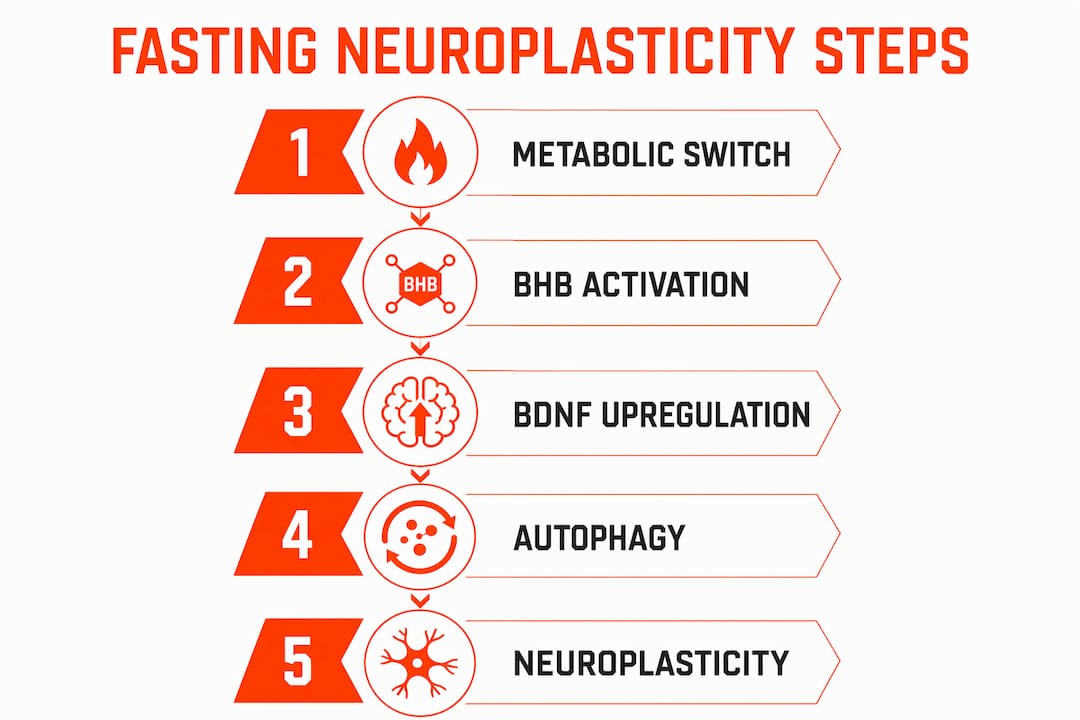
BDNF upregulation in PFC neurons during fasting correlates with enhanced mental flexibility and set-shifting, the cognitive ability to switch between tasks or rules. That is an executive function squarely housed in the PFC. The data come from both animal models and human studies using 48-hour fasting protocols.
Autophagy deserves particular attention here. When glucose drops and mTOR activity falls, PFC neurons begin clearing out damaged organelles and misfolded proteins. This is not cellular damage; it is maintenance. The result is a cleaner, more resilient neural substrate. Fasting essentially gives PFC neurons a scheduled repair window that normal continuous eating never allows.
What behavioral and emotional changes does fasting produce through the PFC?
The neurochemistry above translates into observable outcomes. Some are well-supported; others are more nuanced than popular accounts suggest.
Antidepressant-like effects: Dopamine D1 modulation in the mPFC produces measurable reductions in depression-like behavior in animal models, with the Drd1-BDNF pathway as the confirmed mechanism
Fear extinction and safety learning: Overnight fasting decreases vmPFC and nucleus accumbens activation during safety signal omission, accelerating extinction of conditioned fear responses. fMRI data confirm this is a PFC-specific effect, not a global arousal change
Mood regulation via neuroinflammation reduction: Intermittent fasting reduces systemic and neural inflammation, with PFC circuits directly benefiting. Neuropsychiatric research now treats this as a legitimate complementary approach for mood disorders
Decision-making and executive function: An 8-week randomized trial in older adults with insulin resistance found that intermittent fasting improved executive function and certain memory measures more than a standard healthy diet
Working memory: Elevated BDNF in PFC areas correlates with improved working memory performance, though the effect size varies by fasting duration and individual metabolic state
Cognitive flexibility: Set-shifting improvements tied to BDNF upregulation suggest fasting makes the PFC more adaptable, not just more active
One important caveat: short-term cognitive boosts in healthy adults from fasting are not consistently demonstrated across studies. The mood and clinical benefits are stronger and more reproducible than raw cognitive performance gains in people who are already neurologically healthy.
How do scientists actually study fasting’s effects on the PFC?
The findings above come from a specific toolkit of methods, and understanding them helps you evaluate the strength of any given claim.
Immunohistochemistry: Researchers use antibody staining on brain tissue to visualize receptor expression changes, such as D1 and 5-HT2A upregulation, at the cellular level in PFC subregions
ELISA (enzyme-linked immunosorbent assay): Quantifies protein concentrations like BDNF, p-BAD, and p-AKT in brain tissue samples, providing the numerical data behind receptor phosphorylation findings
Functional MRI (fMRI): Measures blood-oxygen-level-dependent (BOLD) signals to map PFC activation patterns during fasting states; the vmPFC fear extinction data come directly from this method
Behavioral assays: Fear conditioning and extinction protocols, forced-swim tests, and set-shifting tasks translate molecular changes into observable animal behavior, bridging the gap between receptor data and real-world function
Metabolic assays: Blood and cerebrospinal fluid measurements of BHB, glucose, and insulin confirm that the metabolic switch has actually occurred before attributing cognitive effects to ketosis
Optogenetics: Light-activated control of specific neuron populations (like Drd1-expressing mPFC cells) allows researchers to confirm causal relationships rather than correlations
Animal models with defined fasting protocols: Rodent studies typically use alternate-day fasting or time-restricted feeding windows of 9–24 hours; human trials range from overnight fasts to 5:2 protocols extending over weeks
The combination of immunohistochemistry and ELISA with behavioral testing is the current gold standard for connecting molecular receptor changes to functional outcomes in PFC research.
How ForgeFast applies PFC science to build lasting mental resilience
The neuroscience of fasting and prefrontal cortex function is compelling on paper. Translating it into a sustainable practice is where most people stall.
ForgeFast addresses this directly. The methodology, developed by Tony Lindsay, integrates intermittent fasting with structured psychological frameworks designed to reinforce the cognitive gains that fasting biology makes possible.
Structured fasting windows: ForgeFast uses defined eating and fasting periods that align with the metabolic switching timeline, giving BHB-driven BDNF expression time to actually occur
Habit architecture: Rather than relying on willpower, the program builds environmental and behavioral cues that make fasting adherence automatic, reducing the executive load on the very PFC circuits fasting is meant to strengthen
Mental clarity practices: Mindfulness and fasting are paired deliberately, with attention training during fasted states to capitalize on the heightened dopaminergic tone in the mPFC
Decision-making frameworks: ForgeFast’s decision-making guide applies PFC-focused strategies to real-world choices, connecting the biology to daily behavior
Resilience building: The program treats each fasting cycle as a training stimulus for the PFC, not unlike resistance training for muscle, with progressive structure rather than random restriction
Pro Tip: The PFC benefits of fasting compound with consistency. A single 16-hour fast produces a transient BHB spike. Repeated fasting cycles, as ForgeFast structures them, are what drive the autophagy and mitochondrial biogenesis that build lasting cognitive resilience.
The neurological case for consistent fasting is strongest when the practice is structured and sustained, which is precisely the gap ForgeFast fills between the research and real life.
What are the long-term cognitive effects of intermittent fasting on the PFC?
Short-term fasting produces acute neurochemical shifts. Sustained fasting practice produces structural and functional changes that accumulate over months.
Repeated cycles of fasting and refeeding drive progressive mitochondrial biogenesis in PFC neurons, building a more energy-efficient neural substrate. Animal models fed intermittent fasting protocols over extended periods show preserved cognitive function, reduced cortical neuronal loss, and better sensory and motor performance compared to continuously fed controls. The neurological benefits extend well beyond the acute ketone window.
In older adults with insulin resistance, an 8-week 5:2 intermittent fasting protocol reduced the brain-age-gap estimate on MRI, a marker of how fast the brain is biologically aging, and improved executive function. That is a structural finding, not just a performance score. The PFC, which is among the first regions to show age-related volume loss, appears to benefit disproportionately from the neuroprotective effects of repeated metabolic switching.
Long-term fasting also appears to recalibrate fear and stress responses through sustained vmPFC remodeling. Chronic reduction in neuroinflammation, driven by repeated fasting cycles, lowers the baseline inflammatory tone that underlies anxiety and depression. The cumulative effect is a PFC that is more plastic, better regulated, and more resistant to stress-induced dysfunction.
What clinical applications could fasting have for PFC-related disorders?
The therapeutic potential here is real, though the evidence base varies considerably by condition.
For depression and anxiety, the Drd1-BDNF pathway activated by fasting maps directly onto the mechanisms targeted by conventional antidepressants. Intermittent fasting is increasingly recognized as a complementary approach in neuropsychiatric care, particularly for patients who show treatment resistance or prefer non-pharmacological options. The anti-inflammatory effects on PFC circuits add a second mechanism independent of receptor modulation.
For Alzheimer’s disease and cognitive aging, the 8-week randomized trial showing improved executive function and reduced brain-age-gap in insulin-resistant older adults is among the most clinically relevant human data available. Reduced brain glucose on MRI spectroscopy, combined with improved insulin signaling in neuron-derived extracellular vesicles, suggests fasting may slow the metabolic dysfunction that precedes Alzheimer’s pathology.
For PTSD and fear-based disorders, the vmPFC fear extinction finding is particularly striking. Faster safety learning through fasting-induced vmPFC modulation could theoretically augment exposure-based therapies, where extinction speed is a direct predictor of treatment outcome. This remains an active area of investigation.
For epilepsy and multiple sclerosis, clinical evidence already supports ketogenic and fasting-adjacent diets as disease-modifying interventions, with PFC-mediated cognitive improvements documented alongside symptom reduction.
What are the current limitations in fasting and PFC research?
The science is promising but not complete. Several gaps matter for anyone trying to apply these findings practically.
Most mechanistic data come from rodent models. The Drd1-BDNF pathway, the vmPFC fear extinction findings, and the autophagy data are all primarily animal-derived. Human fasting studies are growing in number but remain limited by small sample sizes, short durations, and heterogeneous fasting protocols that make direct comparison difficult.
The absence of consistent short-term cognitive benefits in healthy adults is a real finding, not a methodological artifact. Meta-analyses confirm that fasting’s cognitive advantages in healthy people are modest and inconsistent, while clinical populations with metabolic or neurological impairment show clearer gains. Researchers need larger, longer randomized controlled trials stratified by age, metabolic status, and fasting protocol before clinical guidelines can be updated.
Sex differences, body mass index, and genetic factors like apolipoprotein E genotype all appear to modulate how strongly an individual responds to fasting. The 8-week trial in older adults found that sex and BMI significantly influenced outcomes. Future research needs to account for this variability rather than treating fasting as a uniform intervention.
Finally, the optimal fasting duration, frequency, and timing for PFC-specific benefits remain undefined. Whether 16:8 daily fasting, alternate-day fasting, or multi-day extended fasts produce meaningfully different PFC outcomes is an open question. The answer likely depends on the specific outcome being measured, whether BDNF, fear extinction, executive function, or inflammatory markers.
Key Takeaways
Fasting modulates the prefrontal cortex through specific receptor pathways and metabolic signals, producing cognitive and emotional benefits that are strongest with consistent, structured practice.
Point | Details |
Dopamine D1 drives antidepressant effects | Fasting activates the Drd1-cAMP-PKA-DARPP-32-CREB-BDNF pathway in the mPFC, producing measurable antidepressant-like outcomes. |
BHB signals BDNF expression | β-hydroxybutyrate acts on NF-κB transcription factors to upregulate BDNF, supporting synaptic plasticity and cognitive flexibility. |
vmPFC modulation accelerates fear extinction | Overnight fasting reduces vmPFC activation, speeding safety learning and emotional regulation through a PFC-specific mechanism. |
Long-term fasting builds structural resilience | Repeated fasting cycles drive mitochondrial biogenesis and autophagy in PFC neurons, reducing biological brain aging in clinical trials. |
Healthy adults show modest acute gains | Short-term cognitive boosts in healthy individuals are inconsistent; mood improvement and clinical benefits in disease states are the stronger, more reproducible effects. |
Recommended
Comments