The Role of Mitochondria in Fasting and Metabolic Health


Mitochondria are the primary site of cellular energy production, and fasting is one of the most powerful signals that reshapes how they function. The role of mitochondria in fasting goes far beyond simple fuel switching. When food intake stops, mitochondria activate a cascade of molecular events, including pathways governed by AMPK, SIRT1, SIRT3, and PGC-1α, that improve their own quality, efficiency, and structural integrity. These adaptations drive metabolic flexibility, reduce oxidative damage, and extend the functional lifespan of cells. Understanding this process gives health-conscious individuals and researchers a concrete biological reason to take fasting seriously.
What is the role of mitochondria in fasting?
Fasting is not simply fuel deprivation. It is a key cellular signal that triggers mitochondria to renew themselves, recycle damaged components, and sharpen their energy output. This process is called mitohormesis: a mild metabolic stress that produces lasting improvements in mitochondrial capacity.
The central molecular players are well established. AMPK detects falling ATP levels and activates downstream pathways that promote mitochondrial biogenesis. SIRT1 and SIRT3 are NAD-dependent deacetylases that activate PGC-1α, the master regulator of mitochondrial gene expression. PGC-1α then drives the production of new mitochondria and improves respiratory chain efficiency.
Mitophagy is the selective removal of damaged mitochondria. During fasting, cells ramp up mitophagy to clear dysfunctional organelles before they generate excess reactive oxygen species (ROS). A 4-hour daily fasting protocol in experimental models produced transient ROS that signaled mitophagy, reduced mitochondrial fragmentation, and lowered lipid accumulation. Transient ROS, at the right dose, act as a repair signal rather than a damaging force.
Mitochondrial fusion and fission dynamics also shift during fasting. Fusion elongates mitochondria into networks that share membrane potential and resist autophagy. Fission breaks damaged segments off for disposal. The balance between these two processes determines whether mitochondria emerge from a fast stronger or weaker.

Pro Tip: Track your fasting window consistently for at least two weeks before evaluating energy or metabolic changes. Mitochondrial adaptations are cumulative, not immediate.
How does fasting influence mitochondrial biogenesis and quality control?
Mitochondrial biogenesis is the process of building new mitochondria from existing ones. Fasting drives biogenesis through the SIRT1/PGC-1α axis, which upregulates genes encoding respiratory chain proteins, antioxidant enzymes, and fatty acid oxidation machinery. The result is a mitochondrial pool that is both larger and more efficient.
Quality control runs in parallel. The process works in three layers:
Mitophagy: Damaged mitochondria are tagged with ubiquitin and delivered to autophagosomes for degradation. Fasting accelerates this tagging process.
Fusion/fission balance: Fasting shifts the balance toward fusion, creating elongated networks that dilute damaged components and maintain membrane potential.
Proteomic remodeling: Cells replace dysfunctional proteins within existing mitochondria, a process distinct from full organelle replacement.
Mitofusin 2 (MFN2) is the fusion protein most directly linked to fasting benefits. MFN2 stabilizes mitochondria-endoplasmic reticulum contact sites (MERCs), which are physical junctions where calcium and lipid transfer occurs. When MERCs are intact, mitochondria receive calcium signals that fine-tune ATP production. When MFN2 is deficient, these benefits disappear even if the person is fasting.
Mitochondrial quality control is now recognized as a central mechanism linking fasting to longevity. Cells that clear damaged mitochondria efficiently show better resistance to metabolic disease and age-related decline. Fasting is one of the few non-pharmacological tools that activates this system reliably.
What metabolic adaptations occur in mitochondria across different tissues?
Mitochondrial responses to fasting are not uniform. Each tissue type remodels its mitochondrial proteome according to its specific energy demands.
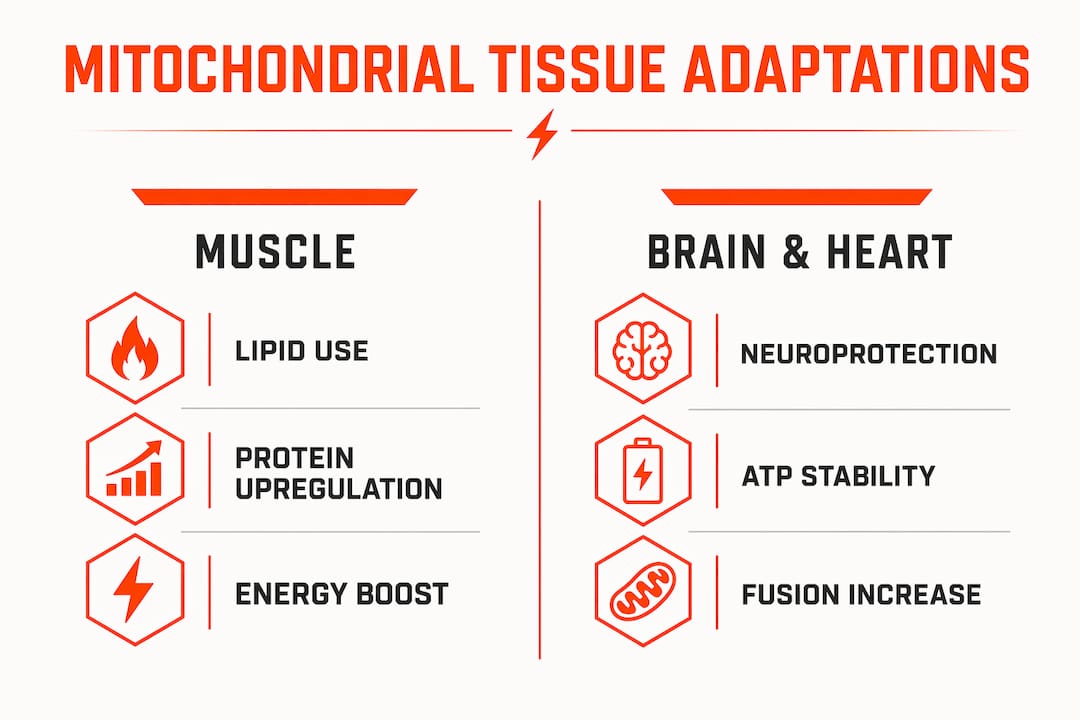
Tissue | Key Mitochondrial Adaptation | Functional Outcome |
Skeletal muscle | Upregulation of 86 proteins for energy sensing; downregulation of OXPHOS proteins | Shift toward lipid oxidation; reduced proton leak |
Liver | Increased fatty acid oxidation enzymes; ketone body production | Fuel export to brain and heart during fasting |
Brain | AMPK and SIRT1 activation; restored neurovascular bioenergetics | Blood-brain barrier protection; neuroprotection |
Heart (cardiomyocytes) | MFN2-driven MERC stabilization; enhanced Ca2+ transfer | Sustained ATP output under low-oxygen conditions |
Skeletal muscle shows the most studied proteomic response. Intermittent fasting upregulates 86 proteins in muscle that enhance energy sensing and mitochondrial function. Simultaneously, oxidative phosphorylation (OXPHOS) proteins are downregulated. This is not a loss of capacity. It is a strategic remodeling that prioritizes lipid oxidation and minimizes energy waste through proton leak.
In the brain, fasting activates AMPK and SIRT1 to restore neurovascular mitochondrial balance and protect the blood-brain barrier. Time-restricted feeding counteracts cerebrovascular aging by keeping mitochondrial bioenergetics in the brain tuned to efficient oxygen use. The neurological benefits of intermittent fasting extend directly from these mitochondrial changes.
In cardiomyocytes, 16:8 circadian fasting increases MFN2 expression, which stabilizes MERCs and sustains ATP production even under hypoxic conditions. This finding matters clinically because cardiac mitochondria face oxygen fluctuations regularly, and structural resilience is what separates a heart that adapts from one that fails.
How do fasting protocols and durations impact mitochondrial function differently?
Not all fasting windows produce the same mitochondrial response. The dose matters, and the timing matters.
Short daily fasts (12–16 hours) produce the most consistent mitochondrial benefits for most people. The 16:8 protocol aligns fasting with the body’s circadian rhythm, reinforcing mitochondrial structural adaptations and MERC stability. Circadian alignment amplifies the AMPK and SIRT1 response because these pathways are themselves regulated by the molecular clock.
Prolonged fasts (24–72 hours) drive deeper mitophagy and more pronounced biogenesis, but they also carry risk. Excessive fasting can cause maladaptive mitochondrial stress, where ROS production exceeds the cell’s antioxidant capacity and damages the very mitochondria the fast was meant to repair. The hormesis curve applies directly here: the right dose improves function, and too much causes harm.
Key practical considerations for protocol selection:
Frequency: Daily time-restricted feeding produces cumulative mitochondrial adaptations more reliably than occasional multi-day fasts.
Circadian alignment: Fasting windows that end before evening preserve mitochondrial efficiency better than late-night eating patterns.
Refeeding quality: The nutrients consumed after a fast directly support mitochondrial rebuilding. Protein and micronutrients like magnesium and B vitamins are required for respiratory chain function.
Individual variation: Sex, age, and baseline metabolic health all influence how mitochondria respond to fasting. Women, for example, show distinct hormonal interactions with fasting protocols that affect mitochondrial signaling.
Pro Tip: If you are new to fasting, start with a 12-hour overnight window and extend by 30 minutes each week. This gradual approach lets mitochondrial quality control systems adapt without triggering maladaptive stress.
The fasting and hormonal optimization connection is relevant here because hormones like cortisol and insulin directly regulate AMPK activity, which sits upstream of every major mitochondrial adaptation.
What practical benefits arise from mitochondria-focused fasting?
The mitochondrial adaptations triggered by fasting translate into measurable health outcomes across multiple systems.
Improved insulin sensitivity. Mitochondrial remodeling in muscle shifts fuel use toward lipid oxidation, which reduces glucose dependence and improves insulin signaling. This is the cellular basis for fasting’s well-documented metabolic benefits.
Greater oxidative stress resistance. Mitohormesis trains mitochondria to handle ROS more efficiently. Cells that have been through repeated fasting cycles show stronger antioxidant enzyme expression and less oxidative damage at baseline.
Cardiovascular resilience. MERC stabilization in cardiomyocytes means the heart sustains ATP output under stress. This structural benefit does not come from caloric restriction alone. It requires the specific signaling environment that fasting creates.
Neuroprotection. Fasting-induced mitochondrial adaptations in the brain protect neurons from energy failure and reduce neuroinflammation. AMPK activation in neurovascular tissue preserves the blood-brain barrier, which is one of the earliest structures to deteriorate in cognitive aging.
Healthspan extension. Mitochondrial quality control driven by fasting removes the damaged organelles that accumulate with age and drive cellular senescence. Clearing this burden slows the biological aging process at the cellular level.
“Fasting is one of the few interventions that simultaneously improves mitochondrial quality, reduces oxidative burden, and enhances metabolic flexibility across multiple organ systems. The evidence now positions mitochondrial renewal as the central mechanism behind fasting’s health benefits.”
My read on where mitochondrial fasting science is headed
The field is moving faster than most practitioners realize. The discovery that mitochondrial structural dynamics, specifically MERC integrity and fusion/fission balance, determine whether fasting benefits materialize is a genuine paradigm shift. For years, the conversation focused on caloric restriction and autophagy in general terms. Now the research points to specific structural checkpoints that either allow or block the metabolic payoff.
The most common misconception I see is that longer fasts are always better for mitochondria. The hormesis curve is real. A 4-hour daily fast in controlled models produced clear mitochondrial renewal. Pushing well beyond that without adequate recovery and refeeding can tip the system into maladaptive stress. The goal is not maximum deprivation. It is the right signal, delivered consistently.
Emerging technologies for monitoring mitochondrial function, including continuous metabolite sensors and wearable-linked metabolic trackers, will eventually let individuals see their mitochondrial response in near real time. Until that becomes widely accessible, the most reliable proxy is metabolic flexibility: how smoothly you shift between glucose and fat as fuel sources.
My practical advice is to prioritize circadian alignment over fasting duration. A consistent 16:8 window that ends by early evening will produce better mitochondrial outcomes than an irregular 20-hour fast that disrupts sleep and cortisol rhythms. Structure and consistency are what the biology actually rewards.
— Tony Lindsay
ForgeFast and the science of sustainable fasting
The mitochondrial science is clear: consistent, well-structured fasting produces real biological change. Translating that into a daily practice is where most people struggle.

ForgeFast is built around exactly this challenge. The ForgeFast method integrates the biological principles of mitochondrial adaptation with a structured lifestyle framework that addresses the psychological side of fasting. The approach emphasizes consistency, circadian alignment, and habit formation over extreme protocols. The ForgeFast app supports readers in tracking their fasting windows and observing metabolic responses over time, giving the structure that mitochondrial adaptations actually require to take hold.
Key Takeaways
Fasting drives mitochondrial renewal through AMPK, SIRT1, PGC-1α, and MFN2 pathways, and consistent circadian-aligned protocols produce the most durable metabolic benefits.
Point | Details |
Mitohormesis is the mechanism | Transient ROS from fasting signal repair and renewal, not damage, when the dose is appropriate. |
Tissue responses differ | Muscle prioritizes lipid oxidation; brain protects neurovascular function; heart stabilizes MERC contacts. |
Protocol design matters | Circadian-aligned 16:8 fasting produces more consistent mitochondrial benefits than irregular prolonged fasts. |
Structural dynamics are critical | MFN2 and MERC integrity determine whether fasting signals translate into actual metabolic improvements. |
Quality control drives longevity | Mitophagy clears damaged mitochondria and reduces cellular aging; fasting is one of the strongest activators. |
FAQ
What is the role of mitochondria during fasting?
Mitochondria shift from glucose-based energy production to fatty acid oxidation during fasting and activate quality control processes including mitophagy and biogenesis. These adaptations improve cellular efficiency and reduce oxidative damage over time.
Can fasting improve mitochondrial efficiency?
Yes. Fasting activates AMPK and SIRT1 pathways that drive PGC-1α-mediated biogenesis and mitochondrial remodeling, producing measurable improvements in respiratory capacity and fuel flexibility.
How does intermittent fasting affect mitochondria differently than prolonged fasting?
Daily intermittent fasting produces cumulative, adaptive mitochondrial improvements through consistent signaling. Prolonged fasting drives deeper mitophagy but risks maladaptive stress if recovery and refeeding are inadequate.
Which tissues benefit most from fasting-induced mitochondrial changes?
Skeletal muscle, brain, and heart all show distinct mitochondrial adaptations. Muscle shifts to lipid oxidation, brain protects neurovascular function, and heart cardiomyocytes stabilize energy transfer under low-oxygen conditions.
How long does it take for fasting to improve mitochondrial function?
Mitochondrial adaptations are cumulative and typically require consistent fasting over several weeks to produce measurable changes in metabolic flexibility and oxidative stress resistance.
Recommended
Comments